



How Cyan, Magenta, Yellow, and Black became the foundation of modern printing — creating millions of colors from just four simple inks.
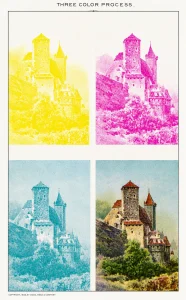
CMYK Printing is the technology behind almost every colorful printed product we see today. From magazines and packaging to posters and brochures, CMYK Printing uses four basic inks — Cyan, Magenta, Yellow, and Black — to create millions of colors. This four-color printing system has transformed commercial printing by making high-quality color reproduction faster, more efficient, and widely accessible.
The story of CMYK is the story of how printers learned to reproduce the world’s colors using just four carefully controlled ink layers.
The Science Behind Four Colors
Digital screens use RGB light to create colors. CMYK Printing works differently because inks absorb and reflect light.
Cyan, Magenta, and Yellow combine to create a wide range of colors, while Black — represented by “K” for the key plate — adds depth, sharpness, and stronger contrast.
Without the black component, combining the three colors would produce an imperfect dark tone rather than a true black.
Why Is Black Called “K”?
One of the biggest questions in printing is why black is not represented as “B”.
The answer comes from the printing process. Black acts as the “Key” color because it provides the important details, outlines, and definition that bring printed images to life. It also reduces ink usage and improves consistency during production.
The Secret Behind Millions of Colors
A printer does not actually print millions of individual colors. Instead, it uses a technique called halftoning.
Tiny dots of CMYK inks are placed in different sizes and patterns. When viewed from a normal distance, our eyes blend these dots together, creating the appearance of continuous shades and detailed images.
This optical effect allows four inks to create detailed and colorful prints.
The Revolution of Commercial Printing
Industries worldwide adopted CMYK for commercial printing.
Before CMYK, producing colorful printed materials required complicated processes with multiple printing plates and inks. The four-color process made large-scale color printing faster, more efficient, and more affordable.
Why CMYK Still Rules Printing Today
Even with advanced digital printing technologies, CMYK remains the foundation of com
mercial printing because of its reliability, efficiency, and ability to produce high-quality results across different applications.
From a magazine page to a food package, the colors we see every day are created through a precise balance of four simple inks.
Printers create millions of colors by combining different percentages of CMYK inks.