


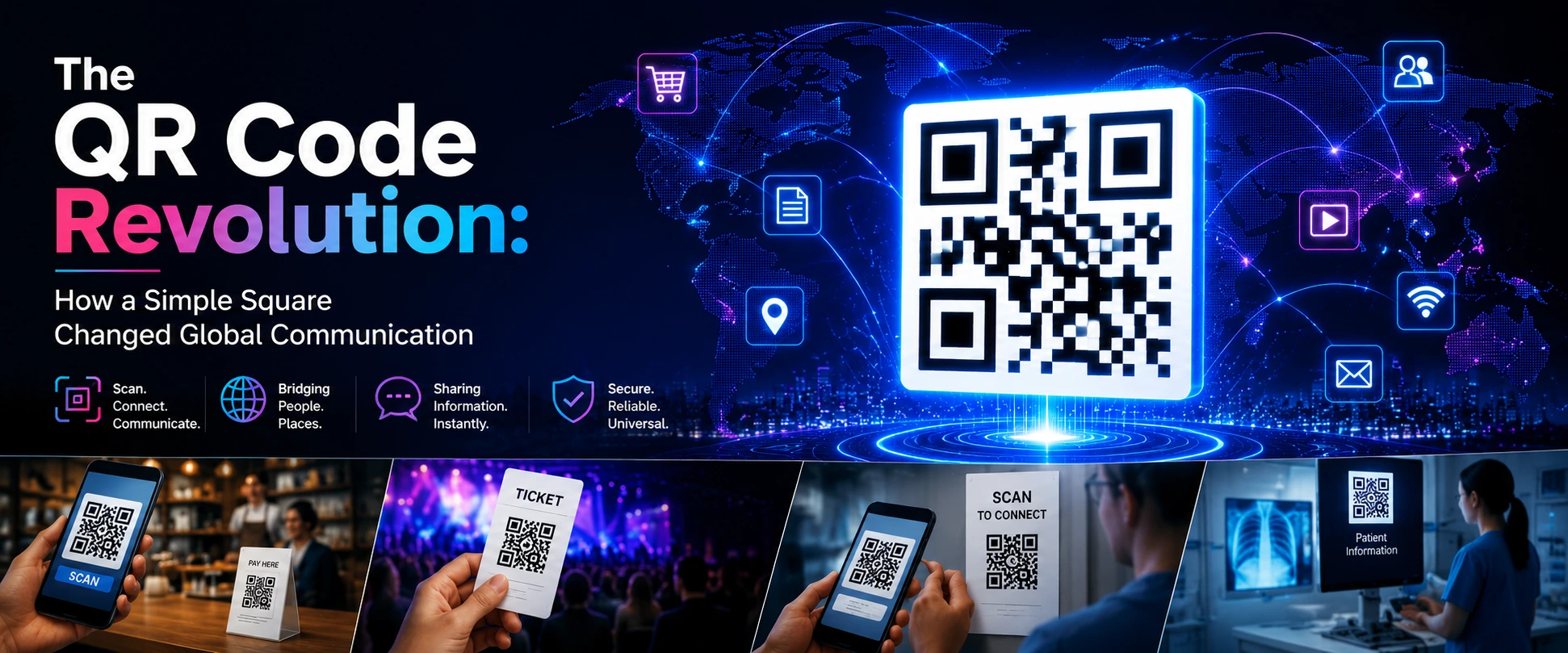
Born from a need to improve retail efficiency in Japan, the QR Code evolved into one of the world’s most influential printing and information technologies, transforming industries, commerce, and everyday life.
Today, QR Codes are everywhere—on product packaging, event tickets, restaurant menus, advertisements, business cards, and mobile payment systems. Yet few people know the remarkable story behind this technology and how it revolutionized the printing and information industries.
The origins of the QR Code can be traced back to Japan’s rapid economic expansion during the 1960s. As supermarkets and retail stores multiplied across the country, checkout counters faced a growing challenge. Cashiers were required to manually enter product prices into cash registers, leading to repetitive strain injuries and inefficiencies in daily operations. The introduction of barcodes provided a major breakthrough by allowing products to be scanned electronically, but the technology soon revealed its limitations. Traditional barcodes could store only a small amount of information, restricting their usefulness in increasingly complex supply chains.
Recognizing the need for a more advanced coding system, customers approached DENSO WAVE, then a division of DENSO Corporation, with a request for a code capable of storing significantly more information, including Japanese Kanji and Kana characters. Inspired by this challenge, engineer Masahiro Hara and a small development team embarked on a mission to create a next-generation two-dimensional code.
Unlike conventional barcodes that store data in a single direction, the new system encoded information both horizontally and vertically, dramatically increasing storage capacity. However, the team’s greatest challenge was ensuring that the code could be read quickly and accurately. The breakthrough came with the invention of the now-famous square position-detection patterns placed in three corners of the code. These distinctive markers enabled scanners to instantly identify the code’s orientation from any angle, making high-speed reading possible.
After eighteen months of intensive development and experimentation, the team successfully created a code capable of storing approximately 7,000 numerical characters while being read more than ten times faster than other two-dimensional codes available at the time. In 1994, DENSO WAVE officially introduced the technology and named it the “QR Code,” short for “Quick Response,” reflecting its speed and efficiency.
The automotive industry was among the first sectors to adopt QR Codes, using them in electronic Kanban systems to improve production management and logistics. Soon afterward, industries such as food processing, pharmaceuticals, and healthcare embraced the technology to enhance product traceability and supply chain transparency.
One of the most significant factors behind the QR Code’s global success was DENSO WAVE’s decision to make the technology openly available. Although the company retained patent rights, it chose not to enforce them, allowing businesses worldwide to use the technology freely. This open approach accelerated adoption across countless industries and applications.
The technology gained widespread public recognition in the early 2000s when mobile phones equipped with QR Code readers entered the market. Consumers could instantly access websites, download coupons, purchase tickets, and retrieve information simply by scanning a printed code. What began as an industrial tool quickly became an integral part of everyday life.
Over the years, QR Code technology has continued to evolve. Variants such as Micro QR Codes, iQR Codes, and FrameQR have expanded its capabilities, enabling smaller sizes, greater data capacity, enhanced privacy, and even creative design integration. Today, QR Codes remain a vital bridge between the physical and digital worlds.
From a modest effort to improve retail operations to a technology recognized worldwide, the QR Code stands as a testament to how innovation in printing and data management can transform industries and reshape modern communication.