


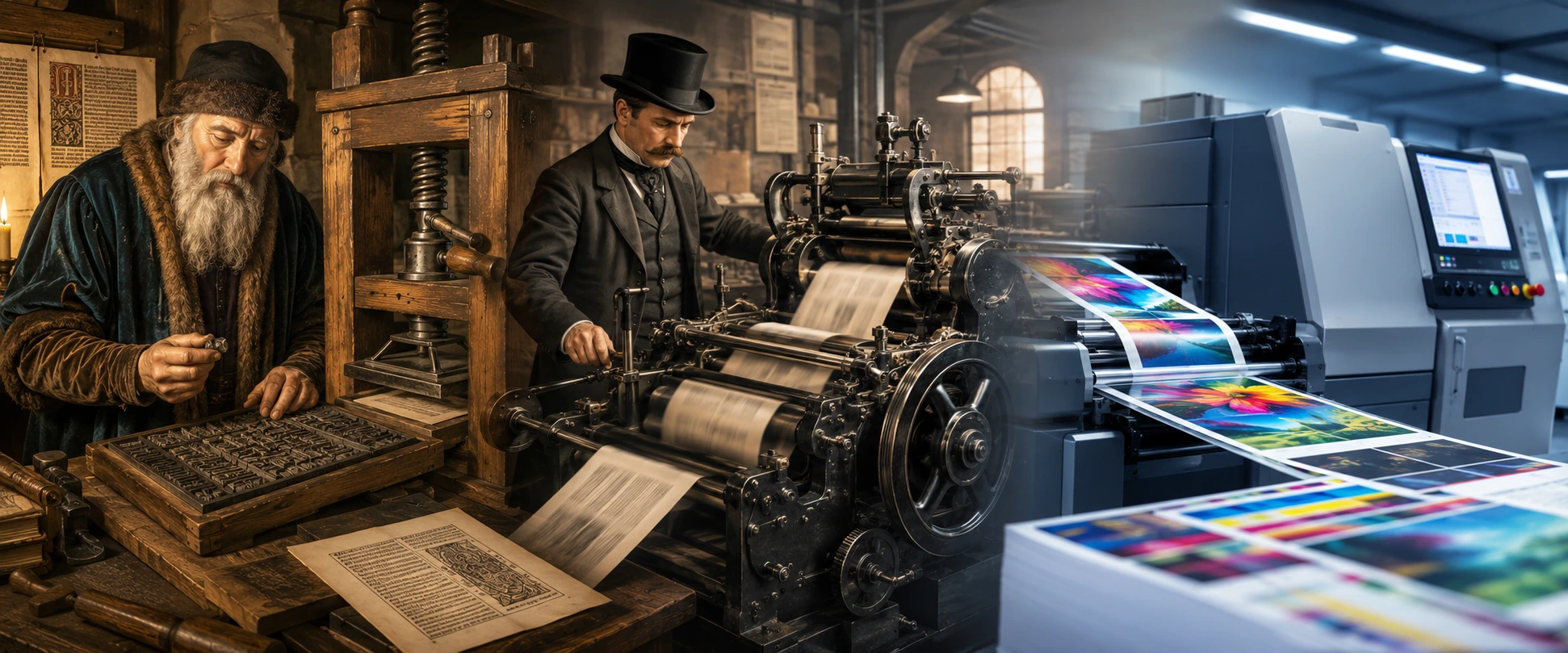
From movable type and steam-powered presses to digital workflows and AI-driven production, the story of print is one of constant reinvention.
The printing press stands among the most transformative inventions in human history. For centuries, it has played a crucial role in spreading knowledge, preserving culture, and driving communication across societies. While modern printing technologies continue to evolve at a rapid pace, the foundations of the industry can be traced back to innovations that emerged centuries ago.
Contrary to popular belief, the origins of printing did not begin in Europe. Paper and movable type were first developed in Asia, and the oldest known surviving book printed using movable type, the Jikji, was produced in Korea in 1377. However, it was in Europe during the 15th century that printing became mechanized, paving the way for mass communication on an unprecedented scale.
The earliest known reference to a mechanized printing press in Europe dates back to 1439 in Strasbourg, where records reveal the construction of a press by Johannes Gutenberg and his associates. Gutenberg’s breakthrough was not simply the invention of movable type, but the successful integration of movable metal type, oil-based inks, and a screw-operated press into a practical and efficient printing system.
Using this technology, Gutenberg produced his famous Bible in 1455, regarded as the first complete extant book printed from movable type in the Western world. The Gutenberg Bible marked a turning point in the dissemination of information and remains one of the most significant milestones in printing history.
The design of Gutenberg’s press was inspired by existing screw presses used for wine and olive production. A large wooden screw exerted pressure on paper placed over movable type, transferring inked text onto the sheet. Although revolutionary for its time, the press was capable of producing only around 250 sheets per hour on one side. Remarkably, this basic design remained largely unchanged for more than three centuries.
The next major leap occurred during the Industrial Revolution. By the late 18th century, metal presses began replacing traditional wooden models, while steam power introduced new possibilities for increasing production speeds. In the mid-19th century, American inventor Richard M. Hoe developed the power-driven rotary press, capable of producing approximately 8,000 sheets per hour. This breakthrough transformed newspaper production and enabled the mass circulation of printed information.
Another milestone arrived with the development of offset printing during the late 19th century. Offset presses offered superior efficiency and quality, particularly for colour printing. Throughout the 20th century, offset lithography became the dominant printing method for newspapers, magazines, books, business forms, and direct mail, establishing itself as the backbone of commercial printing worldwide.
Between 1900 and the 1950s, numerous mechanical improvements enhanced press performance. Better paper feeding systems, automatic reels, improved plate technologies, and photoelectric colour registration controls contributed to higher speeds and greater accuracy. While these developments were incremental, they collectively helped shape modern production printing.
The arrival of computers in the 1950s ushered in a new era for the industry. Digital technologies gradually replaced many traditional composition and prepress processes, streamlining workflows and improving efficiency. As computing power advanced, printing became increasingly automated and data-driven.
By the end of the 20th century, print-on-demand technology emerged as another significant innovation. This approach enabled economical short-run production, reducing inventory requirements and allowing greater customization. At the same time, the printing industry faced growing competition from digital communication platforms and online publishing.
Today, printing continues to evolve. UV printing, automation, artificial intelligence, cloud-based workflows, smart packaging, variable data printing, and sustainable production methods are redefining what modern print operations can achieve. Far from becoming obsolete, printing has continually adapted to technological change, demonstrating a remarkable ability to reinvent itself across generations.
From Gutenberg’s wooden press to today’s intelligent production systems, the story of printing is one of constant innovation. More than five centuries after the first mechanized presses appeared in Europe, the industry remains a vital force in communication, packaging, publishing, and manufacturing—proving that the power of print continues to endure.