


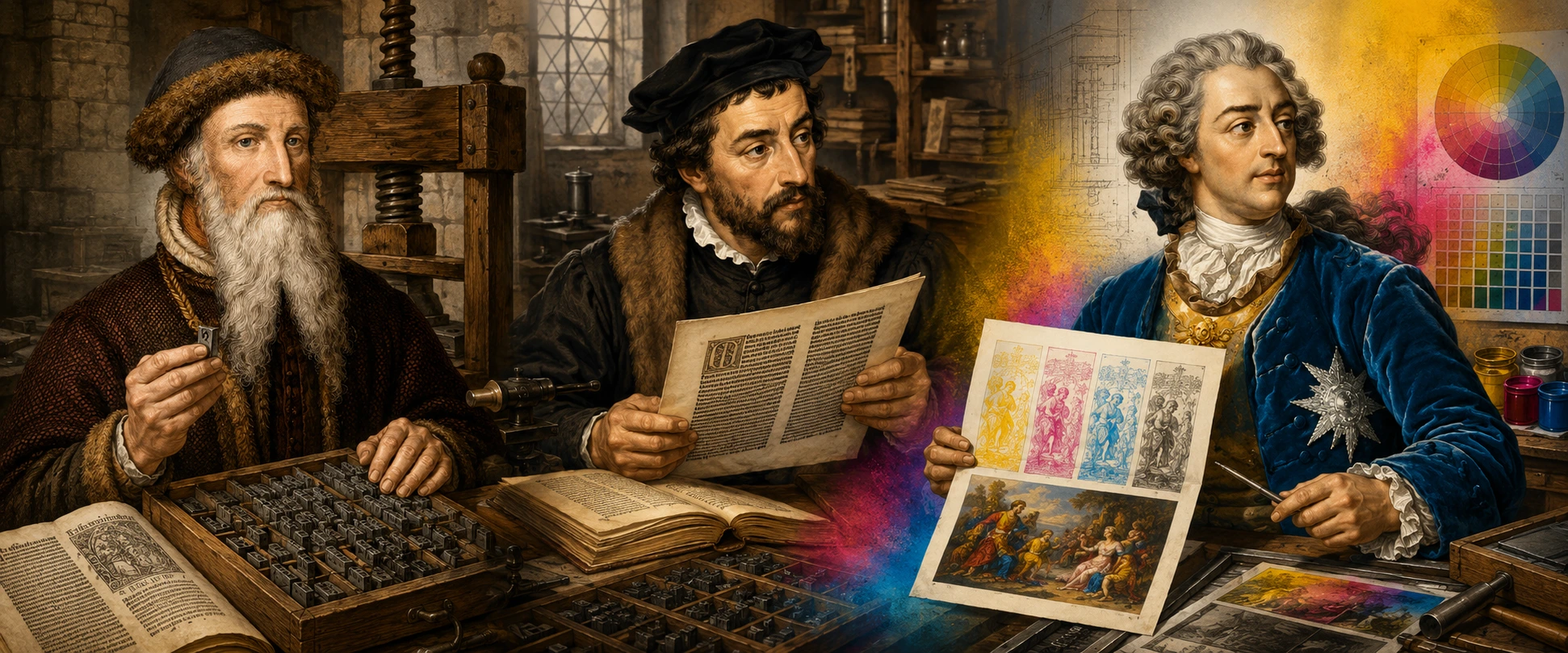
How centuries of innovation transformed simple ink impressions into the vibrant color printing technologies we rely on today
Today, color printing is an essential part of everyday life, influencing everything from packaging and magazines to advertising, labels, and commercial print applications. Yet the origins of color printing stretch back more than 500 years, long before the development of modern offset, flexographic, gravure, or digital printing technologies.
One of the earliest known examples of color printing dates back to 1457, when a Psalter produced during the Gutenberg era featured decorative capital letters printed in two colors. This achievement was made possible through the use of separate woodblocks that were carefully fitted together and inked individually. Considering the limited tools and techniques available at the time, this was a remarkable accomplishment and demonstrated the printing industry’s early ambition to move beyond simple black-and-white text.
As printing spread across Europe, printers and craftsmen sought ways to reproduce images with greater visual appeal. During the 16th century, experiments in Germany explored the use of multiple woodblocks to create color illustrations. Each color required its own carved block, and the success of the print depended on precise alignment. Even the slightest shift in position could distort the final image, making color printing a highly skilled and demanding process.
By the 17th century, further advancements emerged as printers began applying different inks to various sections of engraved metal plates. These techniques enabled multiple colors to be transferred onto paper during a single impression, reducing some of the challenges associated with earlier methods. Although labor-intensive, these experiments represented significant progress in the pursuit of realistic color reproduction.
A major milestone arrived in 1719 when French painter and engraver Jacques-Christophe Le Blond patented a revolutionary color printing process in England. His method utilized three primary colors—blue, yellow, and red—along with black for outlines and finer details. Using four separate engraved plates, Le Blond demonstrated that a wide range of colors could be reproduced through carefully controlled combinations of these inks. His pioneering work established the concept of color separation, a principle that remains fundamental to modern printing.
The 19th century brought rapid scientific and technological developments that accelerated the evolution of color printing. Advances in optics, photography, and color theory led to a better understanding of trichromatic color reproduction. The introduction of photographic color separation techniques and halftone screens enabled printers to reproduce images with unprecedented accuracy and detail. These innovations laid the groundwork for the four-color process printing system used throughout the world today.
Modern printing relies on the CMYK process—Cyan, Magenta, Yellow, and Key (Black)—to reproduce millions of colors. Whether on offset presses, flexographic lines, gravure cylinders, or digital production systems, the fundamental concept remains the same: combining multiple colors in precise registration to create a complete image. What once required painstaking manual craftsmanship can now be achieved with advanced automation, color management software, AI-assisted quality control, and high-speed presses capable of producing thousands of impressions per hour.
Despite these technological advancements, the essence of color printing remains rooted in the experiments and innovations of early printers. Their relentless pursuit of richer, more vibrant images laid the foundation for the sophisticated printing technologies that continue to shape communication, branding, and visual storytelling today.
Did You Know?
The principles behind modern CMYK printing can be traced back to color separation experiments conducted more than 300 years ago. The process developed by Jacques-Christophe Le Blond helped establish the foundations of the color reproduction methods still used across the global printing industry.
Source: Adapted from research published by Encyclopaedia Britannica – Printing & Publishing / Printing Inks.