


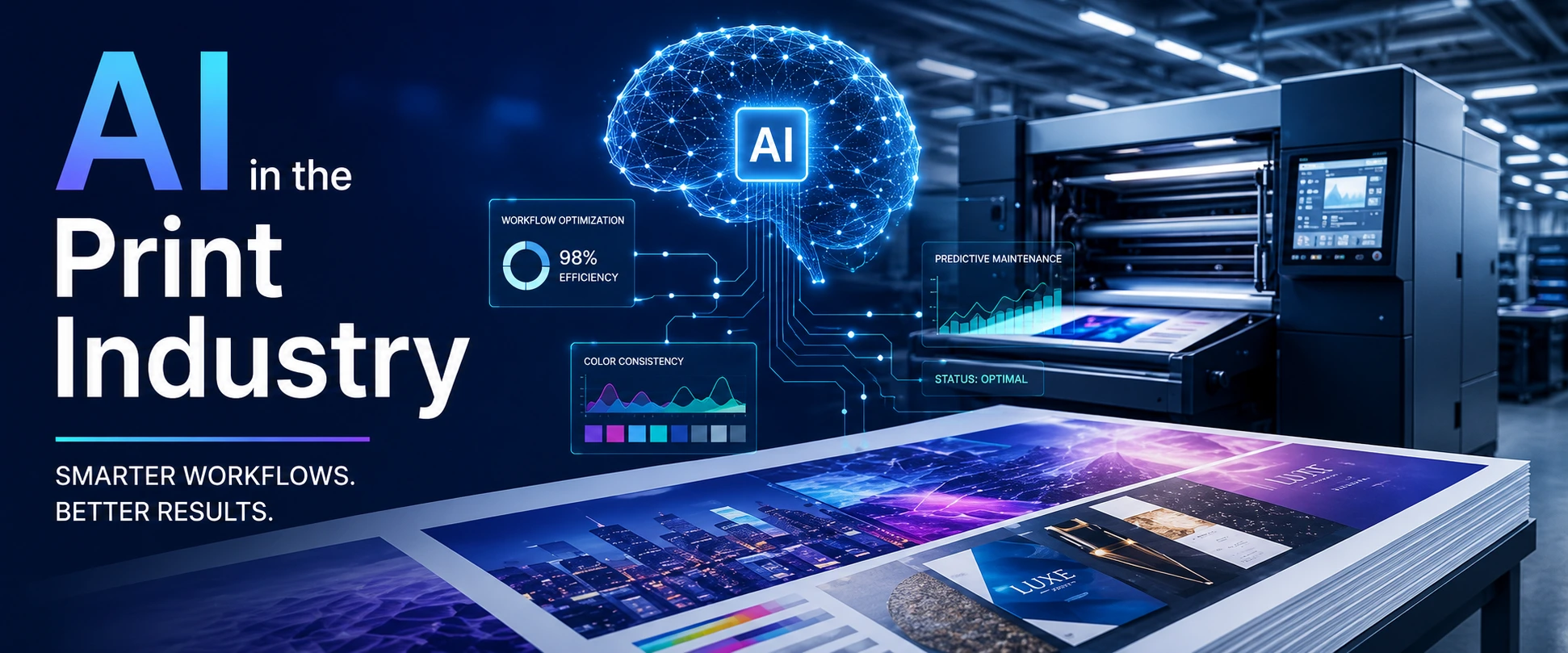
Artificial intelligence is reshaping commercial printing through workflow automation, predictive maintenance, intelligent quality control, and personalized production—helping printers improve efficiency and profitability.
The printing industry has always evolved alongside technological innovation. From traditional offset presses to today’s high-speed digital production systems, every advancement has helped printers improve efficiency, quality, and productivity.
Now, Artificial Intelligence (AI) is driving the industry’s next major transformation.
Rather than replacing printers, AI is helping businesses automate repetitive tasks, improve print quality, reduce waste, optimize production schedules, and make smarter business decisions using real-time data. As customer expectations shift toward faster turnaround times, personalized products, and shorter print runs, AI is becoming a valuable competitive advantage for print service providers.
Today, AI is influencing almost every stage of print production—from design and prepress to production, finishing, quality control, and maintenance.
Why AI Matters in Modern Printing
The printing industry faces several ongoing challenges, including labor shortages, rising production costs, tighter delivery schedules, and increasing customer demand for customization.
AI helps address these challenges by automating routine processes while providing data-driven insights that improve operational efficiency.
Instead of relying solely on operator experience, print businesses can now use AI-powered systems to analyze production data, identify bottlenecks, predict equipment issues, and recommend improvements before problems affect production.
The result is faster decision-making, better resource utilization, and more consistent print quality.
Design Automation and Creative Assistance
Graphic design is one of the earliest areas where AI has made a significant impact.
Modern AI-powered design tools assist designers by generating layouts, enhancing images, recommending typography, and automatically adapting artwork for different print formats.
These capabilities help reduce production time while ensuring design consistency across multiple applications.
AI-assisted design can also identify common prepress issues before files are sent to production, reducing costly errors later in the workflow.
Key Benefits
- Automatic image enhancement
- Smart layout generation
- Artwork resizing for multiple formats
- Font and resolution validation
- Preflight error detection
Smarter Prepress Workflow
Prepress remains one of the most critical stages in print production.
AI-powered workflow software automates many tasks that traditionally required manual intervention, including file verification, color correction, imposition, and print preparation.
Advanced prepress systems can automatically detect missing fonts, incorrect image resolution, registration problems, and color inconsistencies before printing begins.
This reduces production delays while minimizing material waste.
AI-Powered Quality Control
Maintaining consistent print quality has always required experienced press operators.
Today, AI-powered inspection systems use cameras and computer vision to monitor production in real time.
These systems can instantly detect:
- Color variation
- Registration errors
- Print defects
- Ink density fluctuations
- Surface imperfections
When abnormalities are detected, operators receive immediate alerts, allowing corrections before significant waste occurs.
This improves customer satisfaction while reducing production costs.
Predictive Maintenance Reduces Downtime
Unexpected equipment failures can interrupt production schedules and increase operating costs.
AI-powered predictive maintenance continuously monitors machine performance using sensors and production data.
Instead of waiting for equipment to fail, AI identifies early warning signs such as unusual vibration, temperature changes, or declining performance.
Maintenance can then be scheduled before a breakdown occurs.
Benefits include:
- Reduced downtime
- Lower repair costs
- Longer equipment lifespan
- Improved production reliability
Intelligent Workflow Automation
Workflow automation has become one of AI’s biggest contributions to commercial printing.
Modern print management software can automatically process customer orders, estimate pricing, schedule production, allocate jobs to available equipment, and track order progress.
By eliminating repetitive administrative tasks, employees can focus on higher-value activities such as customer service and production optimization.
Automation also improves communication between departments, reducing delays and manual errors.
Personalized Printing at Scale
Variable Data Printing (VDP) has become increasingly important in direct mail, packaging, and marketing communications.
AI makes personalization easier by processing customer data and automatically generating individualized print content.
Examples include:
- Personalized marketing campaigns
- Customized product packaging
- Event invitations
- Loyalty programs
- Direct mail promotions
This allows businesses to deliver highly targeted communications while maintaining production efficiency.
Consistent Color Across Every Job
Color consistency remains one of the biggest quality expectations in commercial printing.
AI-powered color management systems continuously monitor output and automatically adjust ink density and calibration throughout production.
This helps maintain consistent brand colors across different substrates, print runs, and production devices.
For print buyers, this means improved quality and reliable brand reproduction.
AI-Driven Business Intelligence
Beyond production, AI helps print businesses make smarter strategic decisions.
By analyzing production data, customer behavior, machine utilization, and operational performance, AI provides insights into:
- Equipment efficiency
- Production bottlenecks
- Customer buying trends
- Material consumption
- Profitability by job
- Capacity planning
These insights help management optimize resources while improving profitability.
Popular AI Tools Used in the Printing Industry
Several software platforms are already helping printers automate production and improve workflow efficiency.
Some widely adopted solutions include:
- Adobe Firefly
- HP PrintOS
- EFI Fiery
- Kodak PRINERGY
- Enfocus Switch
- PrintIQ
- Xerox AI Workflow Solutions
- GelatoConnect
- SpencerMetrics CONNECT Q
- Canon PRISMA Workflow
Each solution addresses different aspects of print production, including workflow automation, color management, production analytics, scheduling, and quality control.
Challenges of AI Adoption
Despite its advantages, implementing AI requires careful planning.
Print businesses should consider:
- Initial software investment
- Staff training
- Data quality
- Integration with existing equipment
- Cybersecurity
- Change management
AI delivers the greatest value when combined with well-defined workflows and accurate production data.
The Future of AI in Printing
Industry experts expect AI to become an integral part of every stage of print manufacturing.
Future developments are likely to include:
- Fully autonomous print production
- AI-assisted production scheduling
- Robotic material handling
- Self-optimizing printing presses
- Predictive supply chain management
- Real-time production optimization
- AI-powered customer service
- Digital twins for print manufacturing
As these technologies mature, printers will be able to operate more efficiently while responding faster to changing customer demands.
Conclusion
Artificial Intelligence is no longer an emerging technology—it is becoming a practical tool for modern print businesses.
From intelligent workflow automation and predictive maintenance to advanced quality inspection and personalized printing, AI is helping printers reduce costs, improve efficiency, and deliver higher-quality products.
While printing presses remain at the heart of production, the software that connects, monitors, and optimizes those machines is becoming equally important. Businesses that successfully combine advanced printing equipment with AI-driven workflows will be better positioned to meet evolving customer expectations and remain competitive in the years ahead.