


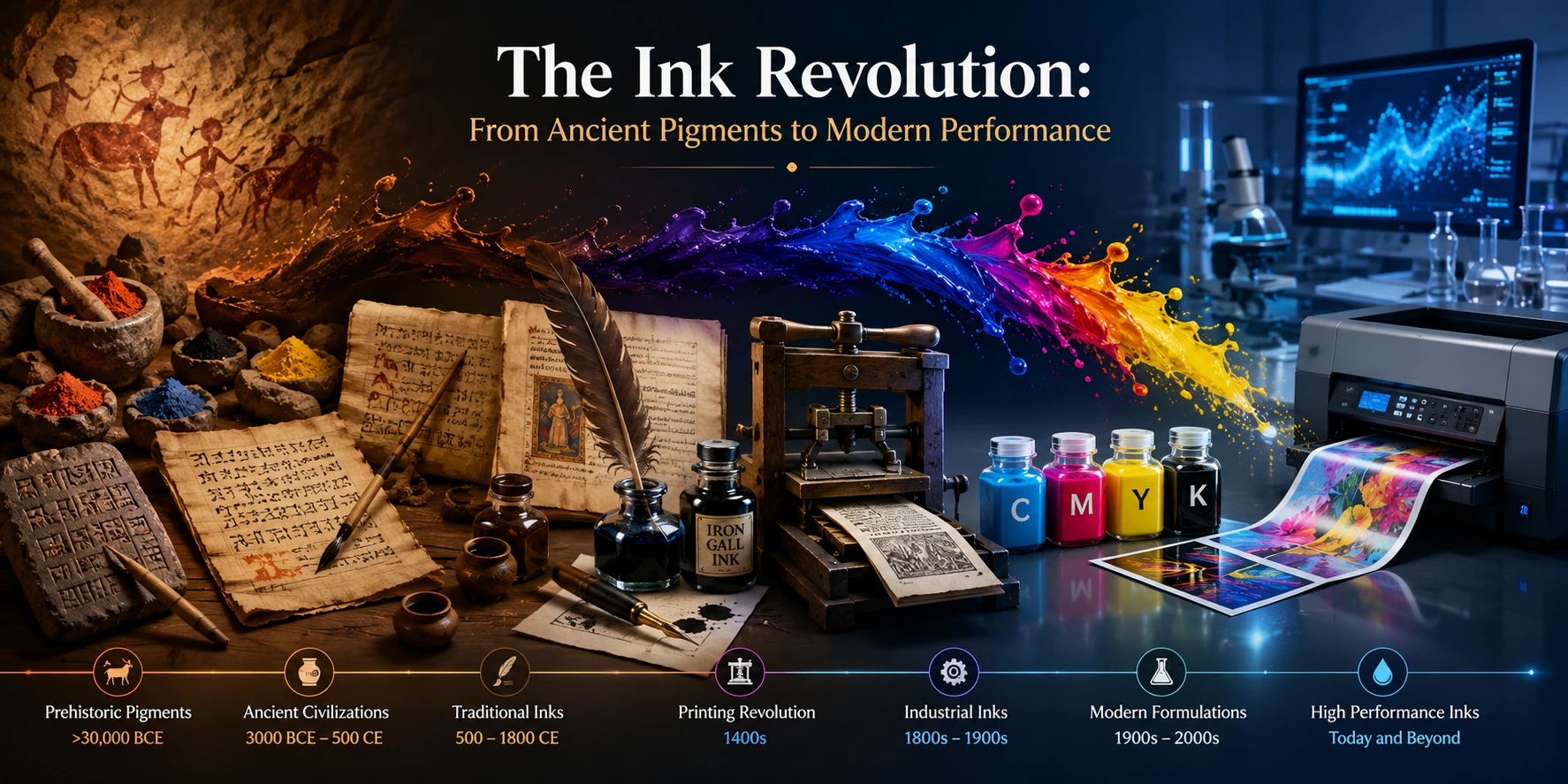
From soot-based inks used by ancient civilizations to today’s high-performance UV-curable and sustainable formulations, printing inks have continuously evolved to meet the changing demands of communication, packaging, and industrial production.
The history of printing is inseparable from the history of ink. For thousands of years, inks have served as the essential medium that transforms ideas into visible communication, enabling the spread of knowledge, culture, and commerce across civilizations. From simple natural pigments used in ancient societies to today’s advanced UV-curable formulations, the evolution of printing inks mirrors humanity’s technological progress and growing demands for quality, efficiency, and sustainability.
Origins in Ancient Civilizations
The earliest inks were created using naturally available materials such as soot, charcoal, plant extracts, minerals, and animal-based binders. Ancient civilizations relied on these primitive formulations for writing, record-keeping, and artistic expression.
In ancient Egypt, scribes produced ink by combining carbon black with gum arabic and water, creating a durable medium for writing on papyrus. Across Asia, Chinese scholars developed ink sticks made from soot and animal glue, which were mixed with water and used for calligraphy and early printing applications. These innovations laid the foundation for written communication and the preservation of knowledge.
Gutenberg and the Printing Revolution
A major turning point arrived in the 15th century with Johannes Gutenberg’s invention of the movable-type printing press. Traditional water-based inks were unsuitable for metal type, prompting the development of oil-based inks made from pigments blended with linseed oil.
These thicker, more durable inks adhered effectively to metal printing surfaces, producing sharper impressions and consistent print quality. The innovation played a critical role in enabling mass production of books, newspapers, and documents, making knowledge more accessible than ever before and accelerating cultural and scientific advancement.
Industrialization and New Printing Processes
The Industrial Revolution transformed printing into a large-scale manufacturing process. As printing technologies advanced, new ink formulations emerged to meet the requirements of faster presses and diverse substrates.
The introduction of offset printing in the late nineteenth century created demand for specialized offset inks capable of transferring efficiently from printing plates to rubber blankets and then onto paper. These inks delivered improved consistency, color accuracy, and production efficiency, making offset printing the dominant commercial printing process for decades.
At the same time, flexographic and gravure printing gained prominence in packaging and publication printing. Flexographic inks were engineered for rapid drying and excellent adhesion on flexible packaging materials, while gravure inks were designed to deliver exceptional image quality and color consistency during long production runs.
The Digital Printing Era
The arrival of digital printing revolutionized the industry once again. Inkjet and laser printing technologies eliminated the need for traditional printing plates, enabling on-demand production, personalization, and shorter print runs.
Inkjet systems use precisely formulated liquid inks containing pigments or dyes suspended in water-based solutions. These inks allow for high-resolution printing across a wide variety of materials. Laser printers utilize toner particles that are fused onto substrates using heat and pressure, ensuring sharp text and graphics for office and commercial applications.
Digital printing’s flexibility and efficiency have made it an essential technology in sectors ranging from publishing and advertising to packaging and textile printing.
The Rise of UV-Curable Inks
Among the most significant developments in modern printing has been the emergence of UV-curable inks. Unlike conventional inks that require evaporation or absorption to dry, UV inks cure instantly when exposed to ultraviolet light.
This technology offers several advantages, including faster production speeds, reduced waste, improved durability, and the ability to print on a broad range of substrates. UV-curable inks have become increasingly important in packaging, labels, commercial printing, and wide-format graphics, where productivity and print quality are critical.
Recent innovations, such as low-tack UV inks designed for sensitive substrates and high-speed production environments, demonstrate how ink technology continues to evolve to meet the needs of modern printers.
Sustainability Drives Future Innovation
Environmental considerations are now shaping the next generation of printing inks. Manufacturers are investing heavily in water-based, low-VOC, and environmentally responsible formulations that reduce emissions and improve workplace safety.
The growing emphasis on recyclable packaging, sustainable production processes, and regulatory compliance is accelerating the adoption of eco-friendly inks across the printing industry. At the same time, advances in chemistry are enabling printers to maintain high performance while reducing environmental impact.
Looking Ahead
From the soot-based inks of ancient civilizations to today’s sophisticated UV-curable and sustainable formulations, printing inks have continuously evolved alongside advances in technology and communication. As the industry embraces automation, digitalization, and sustainability, inks will remain at the heart of printing innovation, helping businesses deliver vibrant, efficient, and environmentally responsible printed products.
The journey of printing inks is far from over. With ongoing research and technological breakthroughs, the next chapter promises even smarter, faster, and greener solutions for the global printing industry.