


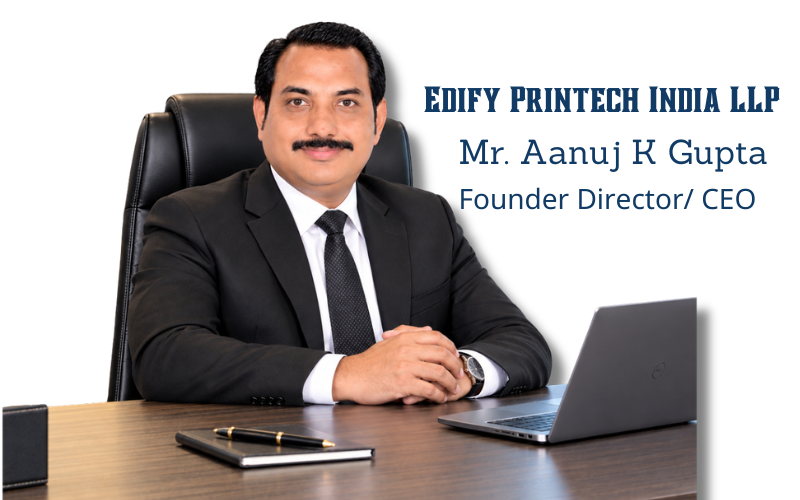
Edify Printech India LLP is an India-based printing technology solutions provider focused on industrial and commercial digital printing. The company equips Indian businesses with advanced printing equipment designed to improve production efficiency, reduce turnaround times, and deliver consistent print quality. Its portfolio includes digital inkjet presses, UV inkjet label printing systems, digital multifunction printers, embellishment solutions, and post-press finishing equipment. Edify emphasizes understanding customers’ production requirements before recommending suitable technologies, helping printing businesses enhance their capabilities and scale their operations. Its solutions cater to applications such as books, magazines, newspapers, school textbooks, manuals, labels, and value-added print finishing.
Print3 : What inspired the founding of Edify Printech and its vision for industrial machinery solutions?
Aanuj K Gupta : The founding of Edify came from something I had observed over years of working in the printing industry. I realized that India did not have a demand problem. It had a capability problem. The ambition was always there. Publishers wanted to print more efficiently, they wanted shorter runs and greater SKU flexibility, faster turnaround and better quality. But, much of the available technology was built around an older production model purpose built for handling larger volumes, longer production cycles, plates and setup costs along with all the other economics of traditional print. The gap in demand and supply is where we saw an opportunity in digital. When we set out to build Edify, we made a very deliberate decision to focus exclusively on digital print technology. We strongly believed that digital printing had the potential to become a much more central part of the industry’s future in India. Digital fundamentally changes and modernises the equation. It removes the minimum volume barrier, reduces plate-related waste and setup requirements, makes personalisation possible and practical, allowing businesses to respond to the changing demands in the market much faster and much smarter.
P3 : How has Edify’s journey evolved to meet the changing needs of Indian printing businesses?
AKG : The dynamics and requirements of the Indian printing industry has become significantly more flexible. Customers today expect quick prints that demand shorter print runs, smaller batches, personalisation, multiple SKUs and increasingly consistent quality. At the same time, while the customers’ demands have evolved, the printers are under pressure to control costs, reduce wastage and improve utilisation of their equipment. Our journey has therefore been about building a portfolio that successfully meets the requirements of the customers, while significantly easing the worries of the printers. We work across three broad areas ranging from Digital Inkjet Production Printer and digital label printing to post production embellishment and other post-press solutions. Along with building a strong portfolio, we have also spent considerable time evaluating and choosing our technology partners internationally. We don’t believe in adding a machine to our portfolio simply because it is new. We look at the technology and analyse its reliability, application potential, service ecosystem and, most importantly, whether it solves a real problem for an Indian customer.
P3 : How do your customized technologies improve productivity across different industrial applications?
AKG : To understand that, the key word here is application. A book printer, a publisher, an FMCG company, a pharmaceutical manufacturer and a label printer may all need digital printing, but their requirements are completely different. Beyond requirements, their individual needs and goals also differ. Perhaps, a publisher may be trying to eliminate overstock and move towards print-on-demand while an FMCG company may need to manage a rapidly increasing number of SKUs. On the other hand, a pharmaceutical company may require high-quality labels with variable information while a commercial printer may need the flexibility to move between very different job sizes. This understanding of subjective requirements, needs and goals is why our process begins with discovery rather than jumping straight to a product catalogue. We assess the customer’s volumes, substrates, workflow, current bottlenecks and growth plans. We then configure the solution around those requirements.
P3 : How is innovation helping Edify address the growing demands of domestic and international markets?
AKG : Innovation has completely changed and is continuing to change what is economically and technologically possible in print. Earlier, the question that dominated was how many copies can you produce. But now, the range of questions has expanded to how quickly can you print, how flexible are your printing configurations, how much cost are you incurring on the setup and the production, can you customers opt for personalisations, and what is the environmental footprint of your machine? The shift in the questions is being addressed by Digital printing technology extremely well. It enables shorter runs, variable data, personalisation, faster turnaround and more efficient production of multiple versions.
This is particularly relevant in India because our market is diverse and increasingly fragmented across regions, languages, SKUs and consumer segments. We see our role as bringing relevant global technologies to India while adapting their application to Indian market realities. That is why international technology partnerships are of great importance to us. We have evaluated and built relationships with technology manufacturers across different segments, including high-speed inkjet, UV inkjet labels and enterprise print infrastructure. Our ambition is not simply to import technology. It is to translate global technology into Indian business opportunity.
P3 : How does Edify identify future opportunities in industrial automation and manufacturing?
AKG : We look at three things together. Technology, customer behaviour and economics. Technology tells us what is possible.Customer behaviour tells us what the market is actually demanding. And economics tells us whether that technology can become a sustainable business opportunity. One way of identifying future opportunities are Industry exhibitions because they allow us to see technologies before they become mainstream. But exhibitions are only one part of the process. We also spend considerable time talking to customers and understanding their production challenges. We have learned that innovation does not necessarily mean introducing the newest machine in the market. Sometimes the real innovation is identifying a technology that already exists globally and finding the right application for it in India.
P3 : What business strategies have helped Edify build lasting relationships with industrial customers?
AKG : Our strategy is simple: we don’t want to sell a machine and walk away. At Edify, the relationship with a customer starts much before the sale does. Our strategy is quite simple, we don’t sell machines and walk away. We walk with the customer before, during and after sale. As already spoken of our process begins with discovery and needs assessment. We understand the customer’s current environment, requirements and growth plans. We then design the solution, conduct demonstrations or proof-of-concept trials where appropriate, install and commission the equipment, train the team and provide ongoing support. This is important because the value of a digital printing system is only realised when it is properly integrated into the customer’s operation. We therefore measure our success not only by the number of machines we place, but by what happens after installation. If the customer’s production improves, and their applications expand and their business grows, then we know that we have done our job right.
P3 : How does your industry experience support customised solutions for diverse manufacturing sectors?
AKG : One of the biggest things my experience in this industry has taught me is that you have to ask the right questions before you recommend the right technology. Over the years working closely with printers and businesses, I realised that customers rarely come to you with just a technology problem alone. They come to you with a business problem. They may be struggling with turnaround time, short-run economics, too many SKUs, substrate requirements, wastage, capacity utilisation, or simply the need to take on an application they could not execute efficiently earlier. That is why at Edify, we don’t believe in taking a machine and trying to fit it into every application.
The same technology can deliver very different results depending on the workflow, media, production volume, application and even the operator environment. Over time, our approach has therefore become much more application-led. This becomes particularly important because digital printing is no longer confined to one particular segment. The requirements of a publishing house can be very different from those of a commercial printer, label converter, packaging business or an enterprise environment. Even within the same sector, two businesses may need completely different configurations based on their workflow and growth plans. Our role at Edify is to bridge that gap between technology and application. We work through the process of understanding the requirement, evaluating the appropriate technology, demonstrating its suitability and then supporting the customer through implementation and operation. For me, that is where industry experience creates real value. It is not simply about knowing what a machine can do but about understanding where it makes business sense for the customer to use it. That distinction is what allows us to build customised solutions rather than simply sell standard equipment.
P3 : What key lessons have shaped Edify’s growth and competitive advantage?
AKG : The first lesson is that technology alone is not the solution. You can have an excellent machine, but if it is not correctly configured, if the customer does not have the right workflow or if the application economics don’t work, the technology will not deliver its potential. The second lesson is that specialisation matters. We made a deliberate choice to focus on digital print rather than trying to be everything to everyone. That focus has helped us build deeper understanding of the technologies and applications we represent. And the third lesson is that trust compounds. In capital equipment, relationships are long-term. A transparent conversation today, even when the answer is not necessarily a sale, can become the foundation for a much larger relationship tomorrow.
P3 : How is digital automation transforming the future of India’s printing sector?
AKG : Digital automation is fundamentally changing the economics of production. We are moving from machines that primarily execute instructions to systems that increasingly participate in managing the production process. Be it automated job processing, intelligent media handling, workflow integration, variable-data production, automated finishing and production monitoring, all can significantly reduce manual intervention and improve consistency. This has become particularly relevant in India because automation can help businesses deal with growing production requirements while making better use of their existing workforce. I personally don’t see automation as simply replacing people. I see it as allowing people to spend less time on repetitive tasks and more time on decisions that actually create value.
P3 : Which technological advancements do you believe will redefine smart manufacturing in India?
AKG : The biggest shift will come from the convergence of digital printing, automation, data and artificial intelligence. Connected equipment will increasingly generate data about utilisation, downtime, production speed, wastage and maintenance requirements. AI and intelligent software will increasingly help with scheduling, predictive maintenance, quality control and workflow optimisation. At the same time, digital inkjet will continue to expand because it offers something particularly valuable to modern businesses: the ability to combine industrial productivity with the flexibility of digital production. For me, the ultimate goal of smart manufacturing is very simple. Move from reactive production to predictive production.
accessible. The important opportunity is not simply replacing offset with digital. It is creating applications that were previously difficult or uneconomical to produce. Print-on-demand is a good example. Instead of producing thousands of copies because the economics demand it and then carrying inventory, businesses can increasingly produce closer to actual demand, all while reducing excessive costs. This changes not just printing but the very business model around printing.
P3 : How is Edify preparing to support next-generation manufacturing technologies?
AKG : We are increasingly investing in technical understanding, something I believe is just as important as machinery if not more. Our objective is to build a team that understands not only what a machine does, but how it does it and where it creates value.
That means strengthening our relationships with global OEMs, continuously evaluating emerging technologies, conducting application trials and learning directly from customer installations. As print becomes more automated, our expertise will also have to become broader. Tomorrow’s print technology partner will need to understand hardware, software, workflow, data and business economics together. That is the capability we are building.
P3 : What role will sustainable and intelligent machinery play in future industrial expansion?
AKG : Sustainability and productivity have now become a part of the same conversation. Digital production can reduce plate requirements, make short-run production more viable, use environment friendly ink systems and reduce the need to produce inventory that may eventually become obsolete.
Intelligent systems can take this further by helping businesses monitor utilisation, wastage and resource consumption. For us, sustainability should not be treated as something separate from business performance. In today’s time, the best technologies are those that use fewer resources while producing greater value.
P3 : How is Edify contributing to Industry 4.0?
AKG : We, at Edify, see our contribution as making advanced digital production technologies more accessible and more practical for Indian businesses. Industry 4.0 can sometimes sound like a very large technological concept. But at the factory or print-production level, it should ultimately translate into very tangible outcomes. That is the direction in which we are building our work and our portfolio. We are increasingly looking at the complete ecosystem around a press which includes the workflow, software, automation, finishing, data and service, rather than treating each machine as an isolated product.