


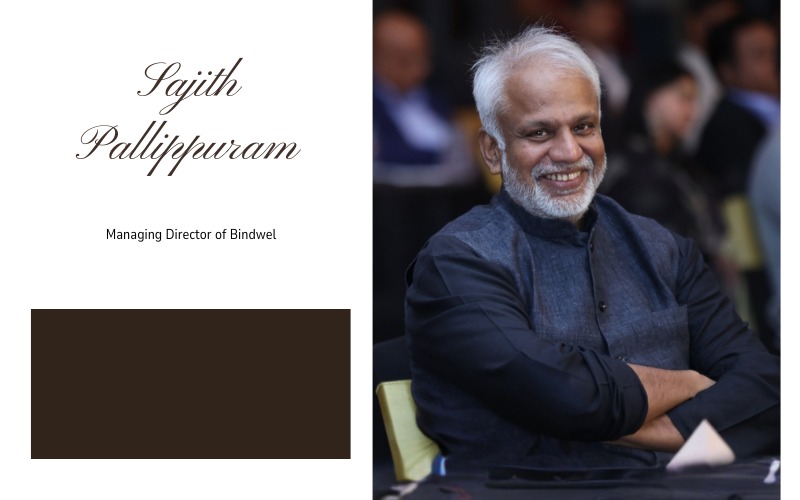
Interview with Mr. Sajith Pallippuram, Managing Director of Bindwel
Bindwel equipment isn’t just a purchaseit’s an investment in lasting quality, performance, and success.
Bindwel’s journey began in 1992 as Impel Services, focused on providing world-class service to the post-press segment. Bindwel was founded with a very clear and focused vision: to build reliable, world-class bookbinding solutions in India, for Indian and global printers, and to remove dependency on expensive, inflexible imported finishing equipment.
In its early years, the focus was on robust engineering, mechanical reliability, and long machine life—qualities that Indian printers valued deeply. As the business scaled, the vision evolved from simply supplying machines to enabling book manufacturing excellence across diverse production environments. Today, we are the largest supplier of bookbinding adhesives in India and a prominent manufacturer whose machines touch 7 out of 8 books made in the country.
Print3 : What was the original vision behind founding Bindwel, and how has that vision evolved over the years?
Sajith Pallippuram : Bindwel’s vision is broader and more forward-looking:
To be a solution partner across the entire spectrum of book production from factory-scale, high-volume textbook manufacturing to agile, data-driven, short-run and on-demand publishing ecosystems. The goal is no longer just “binding books faster,” but helping customers adapt, scale, and remain future-ready.
P3 : What are the major product categories in Bindwel’s portfolio, and what key challenges do they address for book manufacturers?
SP : Major Product Categories:
- Perfect Binders (Freedom Series, EKAM, INSTA): Solve the dilemma of run-length flexibility, from “one-book” models to high-speed mass production.
- Signature Gatherers: Eliminate manual collation errors and increase throughput.
- Three-Knife Trimmers (Trimit Series): Ensure precision finishing and standardized book dimensions.
- Adhesives: Our 30-year partnership with Henkel provides the “glue” that ensures book longevity and quality.
P3 : How have Bindwel’s short-run and digital binding solutions evolved over time, especially compared to earlier generations of machines?
SP : Short-Run & Digital Innovations:
Our modern INSTA and Freedom 2K binders feature QR code-driven automation. These machines can change jobs in under a minute. The INSTA, for instance, reads a QR code on the cover to automatically set the thickness, nipping pressure, and side-gluing, making the “one-book model” commercially viable.
P3 : How has Bindwel integrated adhesives into its overall product and quality strategy?
SP : Quality Control in Bengaluru:
Our facility leverages Bengaluru’s ecosystem of defense and IT expertise. We employ high-end QC systems, rigorous stress testing, and a “lean manufacturing” philosophy that reduces energy consumption and machine complexity while maintaining global performance standards.
P3 : For machines targeted at short-run / digital book production, what technical innovations differentiate them?
SP : Short-run and digital production demand flexibility without compromising quality.
Key differentiators include:
- Compact footprints suitable for digital print environments
- Fast job changeovers with minimal mechanical intervention
- Servo-driven precision for repeatability across varying book sizes
- Optimised milling and gluing systems that handle frequent format changes
These machines are designed for printers who produce many SKUs, smaller batches, and time-critical jobs.
P3 : What manufacturing and quality-control practices ensure global-standard performance?
SP : At Bindwel’s Bengaluru facilities:
- Machines are built using monoblock and rigid-frame construction
- Critical assemblies undergo multi-stage inspection
- Electricals, pneumatics, and safety systems follow international standards
- Every machine is run-tested under load, not just dry-tested
- Continuous design validation is carried out using field data from installations
Quality at Bindwel is not a department—it is a process mindset.
P3 : How does Bindwel respond to trends like on-demand production and automation?
SP : Bindwel addresses these trends through modular design philosophy—allowing customers to start small and scale up.
Automation is introduced where it adds real value, not complexity. Our Sprint-Bind and hybrid workflows reflect this thinking: automation with agility, not automation for its own sake.
P3 : Can you share an example of a recent product or service innovation that reflects Bindwel’s market-driven approach?
SP : The Trimit 30C Prime is a strong example—re-engineered to remove trimming bottlenecks in both offset and digital environments, combining safety, speed, and data-readiness. It directly addressed customer pain points around quality consistency, downtime, and operator confidence.
P3 : What do you consider Bindwel’s key competitive advantage in the global post-press and bookbinding market?
SP : Competitive Edge: Our edge lies in our Total Solution Approach. We don’t just sell a machine; we provide the adhesive, the service, and the workflow expertise. Being “Born in India, Built for the World” allows us to offer European-standard engineering at a cost-structure that works for emerging markets.
P3 : How important is Bindwel’s service network in strengthening customer trust and long-term relationships?
SP : Supply Chain & Service: With 18 centers and 50+ service personnel, our network is the backbone of our brand. We treat service as a product. Our “Service Excellence” model ensures that even in remote regions, a Bindwel engineer is never more than a few hours away.
P3 : How does the new Trivandrum manufacturing facility fit into Bindwel’s long-term growth and manufacturing strategy?
SP : As part of its long-term growth strategy, Bindwel is strengthening its manufacturing capabilities through the establishment of a dedicated manufacturing facility in Trivandrum, Kerala, focused on the SigLoch range of digital and smart post-press machines.
This new facility is designed to support precision manufacturing, modular assembly, and future-ready automation for short-run and digital finishing equipment. It also enables faster product development cycles, improved quality control, and better scalability to serve both Indian and export markets.
P3 : What strategic role will the Trivandrum plant play in supporting digital, smart, and short-run post-press solutions?
SP : The Trivandrum plant reflects Bindwel’s commitment to building globally competitive machines from India, while decentralising manufacturing to specialised centres of excellence.
P3 : How does Bindwel optimise perfect binding parameters to ensure consistent quality and durability?
SP : Through:
- Precision milling geometry
- Controlled glue application systems
- Servo-driven cover nipping
- PLC-HMI controls with real-time monitoring
- Integrated safety sensors and overload protections
P3 : What are the biggest challenges in digital and on-demand book production, and how does Bindwel address them?
SP : Key challenges include frequent job changes, quality repeatability, and small volumes.
Bindwel addresses these through:
- Quick-setup logic
- Intelligent controls
- Stable book handling
- Reduced manual dependency
P3 : What is Bindwel’s growth roadmap for the next three to five years, both in India and internationally?
SP : 3-5 Year Plan: We are focusing on deep-market penetration in Southeast Asia and Africa. In India, we are expanding into the Founders’ Office and GTM strategies to nurture new print-entrepreneurs.
P3 : How does Bindwel balance the needs of high-volume offset production with agile, short-run digital manufacturing?
SP : Balancing Agile vs. High-Volume: We solve this with a modular approach. The Bindline can be configured for high-volume offset runs, while the INSTA handles the “very short” digital runs. We believe the future is hybrid.
P3 : What steps is Bindwel taking to improve sustainability and reduce the environmental footprint of bookbinding operations?
SP : Sustainability: Our “Lean” machines (like EKAM) reduce the carbon footprint per book. We are also pioneering the use of energy-efficient pre-melters and PUR adhesives that require less energy and offer superior recyclability.
P3 : What does the Freedom Bindline installation at Repro India signify for Bindwel and for Indian-made post-press technology?
SP : PrintPack 2025 & Repro India: The sale of the Freedom Bindline to Repro India at PrintPack 2025 highlights our dominance in the large-scale segment. Winning this contract involved demonstrating our ability to handle high-speed, automated production for one of India’s most innovative content aggregators. It proves that Indian technology can successfully compete with and replace expensive European imports.
P3 : How do recent international successes, such as in Indonesia, shape Bindwel’s global strategy?
SP : International Milestones: Our recent successes in Indonesia (where we are replacing legacy European equipment) signal our arrival as a global challenger. These milestones shape our strategy to become the preferred partner for bookbinding in any market that values agility and ROI.
P3 : What does the Crafting Bharat Tech Transformer Innovator Award 2025 mean for Bindwel and its innovation journey?
SP : In 2025, Bindwel Technologies was honoured with the Crafting Bharat Tech Transformer Innovator Award, recognising its contribution to advancing bookbinding and post-press automation in India. The award highlighted Bindwel’s 1NSTA Book on Demand system, a breakthrough solution capable of producing up to 1,000 unique books per hour, enabling true book-of-one production for short-run and personalised publishing.
This recognition reinforces Bindwel’s long-standing focus on solving real-world production challenges through indigenous innovation and future-ready automation.