


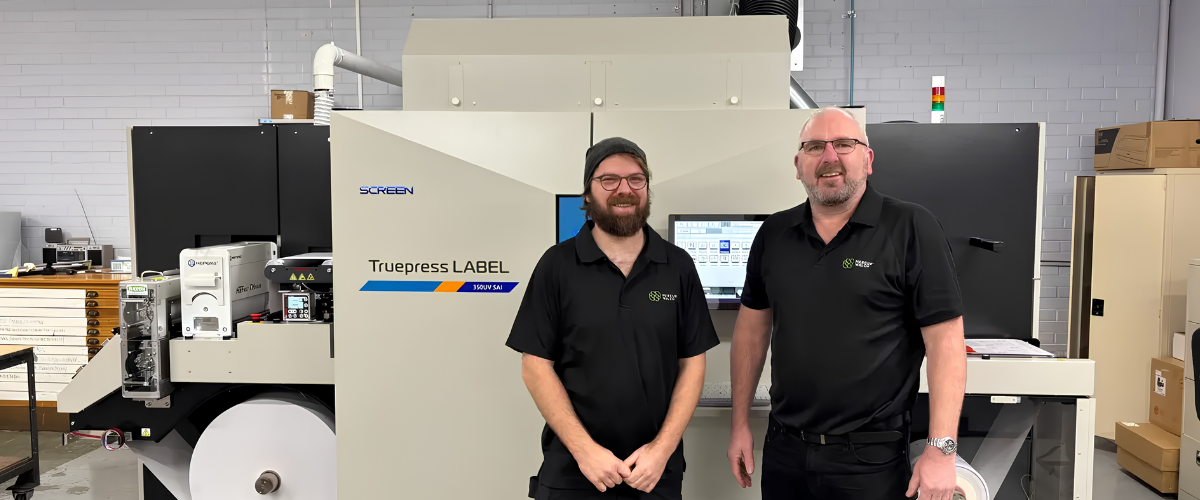
Mercury Walch Expands Hobart Label Production with New Digital Press
Mercury Walch has strengthened its label printing capabilities with the installation of a Screen L350UV SAI-S digital label press at its Hobart operation. The press was supplied by Jet Technologies.
The new system significantly increases production capacity, lifting label printing speeds from around 9 metres per minute to up to 60 metres per minute. The upgrade is expected to help Mercury Walch handle larger orders, improve turnaround times and compete for more label work within Tasmania.
Based in Moonah since the early 1900s, Mercury Walch has developed into Tasmania’s largest sheetfed printer. The company provides commercial and digital printing, direct mail, packaging, large-format point-of-sale materials and label production.
The investment is part of the company’s strategy to expand its label business and bring more work back to Tasmania. Mercury Walch sees an opportunity to capture label jobs that are currently being produced by interstate suppliers while providing local customers with faster delivery and greater production flexibility.
General Manager Adam Glover said customer demand and the limitations of the company’s previous equipment were key factors behind the investment.
“Our previous label press couldn’t print white, which limited the range of work we could produce for customers. If we couldn’t meet all of their label requirements, it made it difficult for them to move their business to us,” Glover said.
The Screen L350UV SAI-S also represents a move toward more advanced digital inkjet technology within Mercury Walch’s label division. The company had been monitoring developments in inkjet printing before selecting the Screen system, with print quality, speed and ease of operation among the factors influencing its decision.
“We’d been watching advances in inkjet technology for some time and were impressed by both the print quality and production speed of the Screen L350UV SAI-S. Combined with its ease of operation, it gives us the confidence to build a stronger label offering for Tasmanian businesses,” Glover said.
With the additional capacity, Mercury Walch expects to pursue customers whose requirements could not previously be fully supported. The company also anticipates improved competitiveness for longer production runs, while shorter lead times could benefit local food producers, manufacturers and other businesses requiring regular label supplies.
“With the new capabilities of the L350UV SAI-S, we’re now able to re-engage prospective customers knowing we can fully support their requirements. Our goal is to keep more label production in Tasmania rather than seeing that work leave the state,” Glover said.
“The increased efficiency also means we can be far more competitive on longer production runs while helping customers reduce lead times. For many businesses, producing labels locally means faster delivery and fewer freight delays,” he added.
The installation further strengthens a longstanding relationship between Mercury Walch and Jet Technologies, which has supplied the printer with consumables and technical support for several decades.
“We’ve had a long-standing relationship with Jet Technologies and have always valued their knowledge across the printing industry,” Glover said. “When we decided to expand further into labels, they were the natural partner to help us bring that vision to life.”
Jet Technologies Managing Director Jack Malki said the investment reflects the growing demand among printers for technology that can expand their product offering while improving production efficiency.
“Printers are increasingly looking for ways to diversify their offering while delivering faster turnaround times and exceptional quality,” Malki said.
He added that the Screen L350UV SAI-S can enable businesses such as Mercury Walch to produce labels at substantially higher speeds, creating opportunities for new revenue while supporting local manufacturing.
The new press is expected to play an important role in Mercury Walch’s continued expansion of its label division and its efforts to retain more label production within Tasmania.