


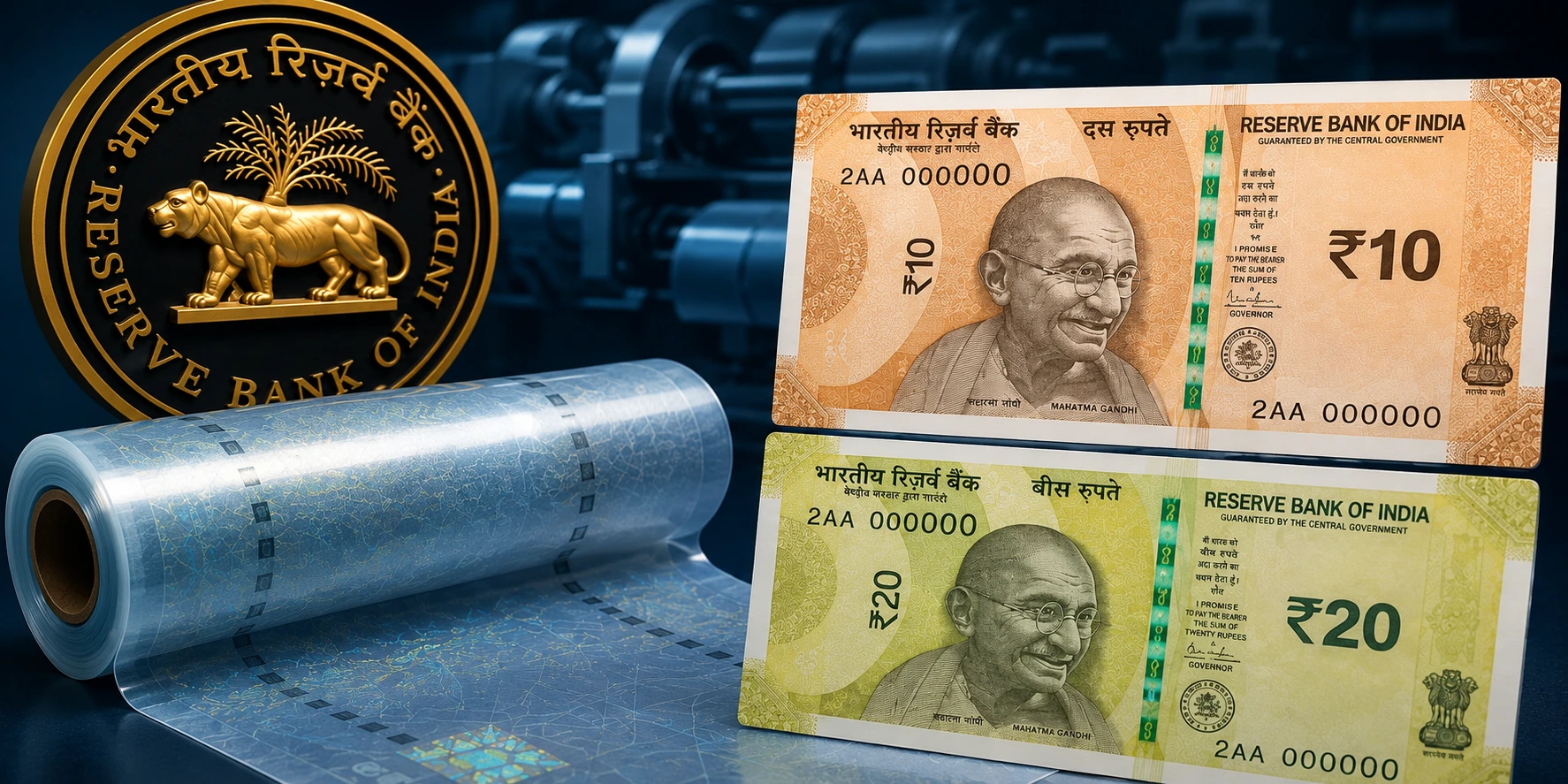
Government approves pilot issuance of polymer banknotes as RBI evaluates advanced substrate technology for secure currency printing.
New Delhi: The Government of India has approved the Reserve Bank of India’s proposal to introduce one billion polymer banknotes each in the ₹10 and ₹20 denominations for field trials, paving the way for the next phase of currency innovation in the country.
The approval was announced by Minister of State for Finance Pankaj Chaudhary in a written reply to the Lok Sabha. According to the minister, the RBI’s proposal—submitted with the recommendation of its Central Board under Section 25 of the Reserve Bank of India Act, 1934—also includes plans for the regular issuance of polymer banknotes after successful completion of the trial phase.
The pilot programme will see polymer notes circulate alongside conventional paper-substrate banknotes. The government clarified that there is currently no proposal to replace existing paper currency entirely, with polymer notes intended to complement the existing currency system.
Polymer banknotes are being evaluated primarily for their longer circulation life and improved durability. According to the RBI, international studies indicate that polymer-based currency lasts significantly longer than conventional paper notes, making it a potentially cost-effective option over the long term despite higher initial production costs.
The initiative also comes as the cost of printing banknotes continues to rise. According to the RBI’s Annual Report for FY2024–25, expenditure on secure currency printing increased to ₹6,372.8 crore, compared with ₹5,101.4 crore in the previous financial year, largely due to higher demand for printed banknotes.
RBI Governor Sanjay Malhotra had earlier confirmed that the central bank was assessing both the advantages and challenges of polymer banknotes. Following successful field evaluation, the findings will help determine the feasibility of introducing the new substrate for regular circulation.
The Finance Ministry also noted that any impact on digital payments can only be assessed after wider circulation of polymer notes. At present, physical currency and digital payment systems are viewed as complementary payment mechanisms serving different user requirements.
India had previously explored polymer banknotes in 2012, but the initiative did not move forward because of technological challenges. Since then, advances in security printing and substrate technology have renewed interest in polymer currency.
Globally, more than 60 countries have adopted polymer banknotes, with Australia becoming the first nation to introduce them in 1988. Countries including Canada, Singapore, Indonesia, Thailand, Malaysia, and Romania have since implemented polymer currency to improve note durability, hygiene, and security against counterfeiting.
For India’s security printing and currency manufacturing sector, the field trials represent an important development that could influence future banknote production technologies and strengthen the country’s currency printing infrastructure.