


Henrik Müller-Hansen says AI, workflow automation, and software will play a critical role in helping print businesses improve efficiency and remain competitive.
Gelato CEO Urges Print Industry to Increase Software Investment for Future Growth
June 30, 2026 – Gelato CEO Henrik Müller-Hansen has called on print businesses to rethink their investment strategies, arguing that greater spending on software, automation, and artificial intelligence will be essential for long-term growth and competitiveness.
Speaking to print industry executives during presentations in Sydney and Melbourne, Müller-Hansen shared his vision of a more digitally connected print industry, where workflow automation and intelligent software play a larger role alongside modern printing equipment.
According to Müller-Hansen, many print businesses continue to prioritise investments in production machinery while allocating relatively little to software that can automate workflows, improve customer experience, and streamline operations.
“You underinvest in software and you overinvest in machines,” he told attendees, suggesting that software investment could become a defining factor for the next generation of print manufacturers.
Software Becoming a Competitive Advantage
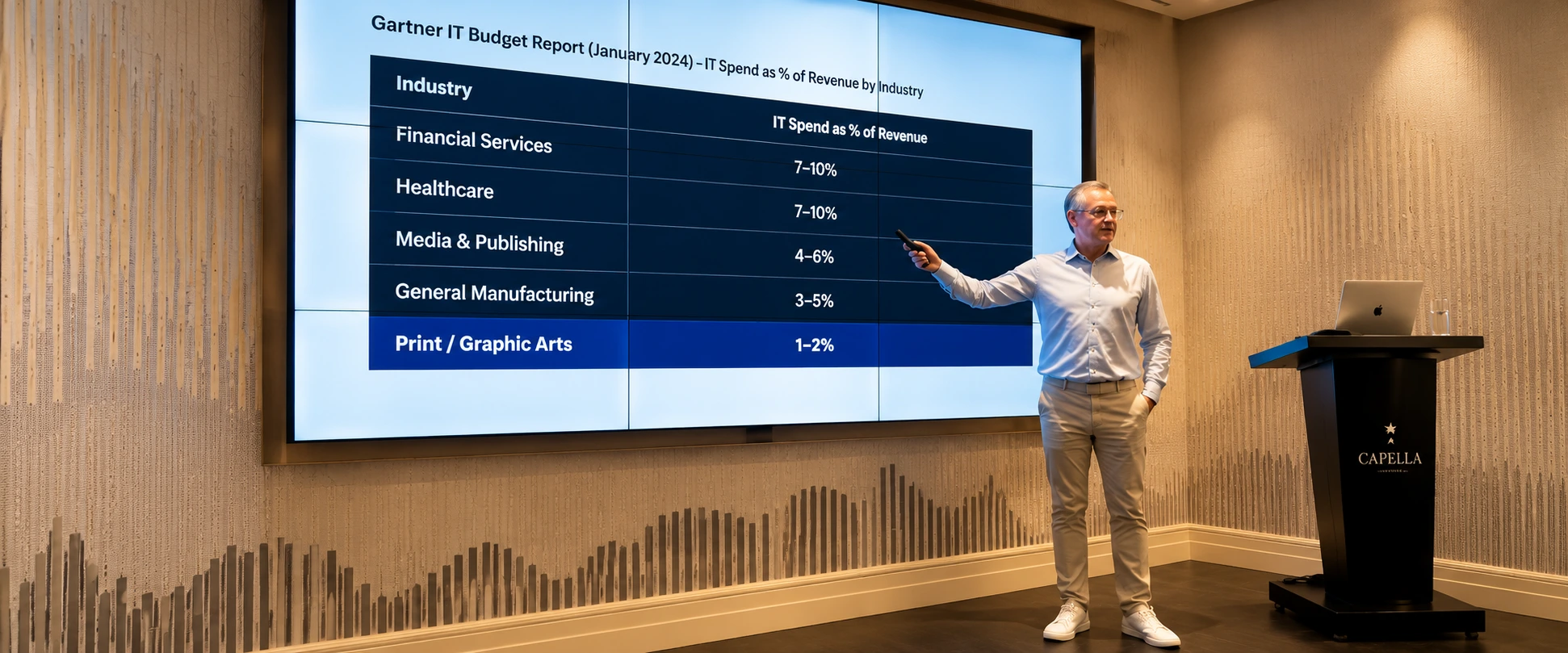
During his presentation, Müller-Hansen compared IT spending across multiple industries, noting that printing and graphic arts currently invest a smaller percentage of revenue in software than many other sectors.
He believes this trend will change rapidly as manufacturers increasingly adopt AI, automation, robotics, and digital workflows to improve efficiency and profitability.
Rather than relying solely on production capacity, Müller-Hansen said successful print companies will increasingly differentiate themselves through faster customer response times, automated quoting, and connected production systems.
AI and Automation Driving Operational Efficiency
A key focus of the presentation was the growing role of AI-powered workflow automation.
Müller-Hansen explained that instant online quoting can significantly improve customer conversion by delivering accurate pricing within seconds instead of hours or days. He also highlighted the importance of integrating estimating, procurement, production planning, logistics, and customer communication into a single digital workflow.
Gelato’s GelatoConnect platform is designed to automate many of these processes, enabling print businesses to manage customer orders, production workflows, and online sales more efficiently.
Preparing for Smaller Print Runs
Müller-Hansen also predicted that customer demand will continue shifting toward shorter print runs with faster delivery and greater personalisation.
He suggested that by 2027, as many as 70% of print jobs could involve quantities of fewer than 100 units, making software-driven production and automation increasingly important for maintaining profitability.
As order sizes become smaller and turnaround times continue to shrink, he believes printers will need more intelligent production management systems capable of handling high volumes of customised work efficiently.
Digital Transformation Remains a Key Opportunity
While acknowledging the print industry’s strong manufacturing expertise, Müller-Hansen encouraged businesses to complement their production capabilities with greater investment in digital technologies.
He said integrating software, AI, and automation into everyday operations can help printers address labour shortages, improve workflow efficiency, enhance customer experience, and build more scalable business models.
“The printers most likely to thrive will be those that adapt fastest to changing customer expectations, simplify how print is bought and produced, and focus on profitable growth,” Müller-Hansen said.
Industry Outlook
The presentation reflects a broader trend across the global printing industry, where software, workflow automation, and artificial intelligence are becoming increasingly important alongside advances in printing hardware. As digital transformation accelerates, many print service providers are evaluating how technology investments can improve productivity, reduce manual processes, and support future business growth.