


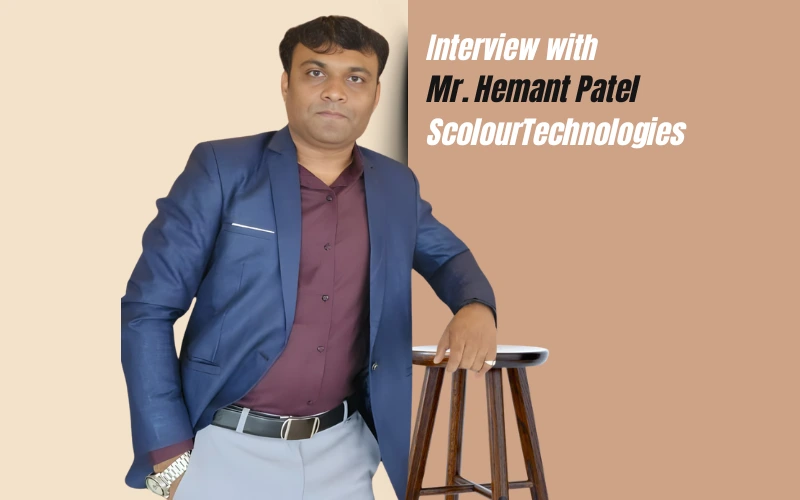
From YCMK to Scolour, evolving from machines to complete technology solutions driving innovation and precision in textile printing.
Print3 : What inspired the founding of Scolour Technologies (formerly YCMK) and how did the transition happen?
Hemant Paatel : Scolour Technologies began its journey as YCMK with a clear vision, to bring innovation and precision into textile printing technology. The transition to Scolour marked our evolution from a machinery maker to a complete technology solutions provider. Our goal has always been to combine engineering excellence with user-centric design and this rebranding reflects our growth, wider product range and commitment to setting new benchmarks in textile printing innovation.
P3 : What is the vision & mission of Scolour and how has it evolved since 2014?
HP : Our vision is to be a global leader in textileprinting and engraving technology by delivering innovative, reliable and sustainable solutions. The mission is to empower the textile industry with advanced, user-friendly machines that enhance productivity and quality. Since 2014, Scolour has evolved from a single-product company into a comprehensive technology provider, expanding into digital printing, automation and turnkey solutions to meet modern industry demands.
P3 : How has the leadership (for example, Mr. Hemant Patel) contributed to shaping the company’s culture and direction?
HP : Mr. Hemant Patel’s leadership has been the driving force behind Scolour’s innovation and growth. His strong technical expertise and customer-focused vision have shaped a culture of precision, reliability and continuous improvement. Under his guidance, Scolour evolved from YCMK into a globally recognized brand known for engineering excellence and forward-thinking technology in textile printing.
P3 : Could you list the main product lines offered by Scolour, including both machines and accessories?
HP : Scolour Technologies offers a complete range of textile-printing and engraving machines, including rotary and flatbed UV laser engravers, inkjet engravers, thermal jet systems, and digital fabric printers. We also provide screenmaking accessories, inks and modular solutions to support the entire textile-printing process.
P3 : What are the key technical specifications of your UV Laser Rotary Engraver and how do they compare with industry standards?
HP : Our UV Laser Rotary Engraver delivers high-precision engraving with ±0.02 mm accuracy, advanced UV laser Diode with Japanese technology and ball-screw linear motion for stability and speed. It supports modular screen sizes and offers efficient air-cooled operation. Compared to industry standards, it provides superior accuracy, faster output and flexible customization, making it one of the most reliable and advanced systems in its segment.
P3 : How does the Flatbed Inkjet Exposing Machine work and what are its unique benefits (speed, cost, precision)?
HP : The Flatbed Inkjet Exposing Machine uses direct-to-screen inkjet technology to print designs precisely onto the mesh, eliminating films and UV exposure. It offers fast operation (around 3 minutes per sq mtr), high accuracy and low running cost,providing superior speed, precision, and efficiency compared to traditional exposure methods.
P3 : How modular are your machine designs? Do you offer custom sizes / configurations based on customer need?
HP : Yes, the machines from Scolour Technologies are built on a highly modular architecture, and we do offer custom sizes/configurations based on customer needs. Here’s a short version you can use: “Our machine designs are engineered for modularity: we offer configurable sizes, head-systems, exposure units and repeat lengths to match customer workflows and space constraints. This flexibility allows us to tailor each installation and optimise machine footprint, output and integration.
P3 : Who are your primary customers (e.g. textile printers, label makers, industrial users), both in India and abroad?
HP : Our primary customers span textile-printing and engraving firms, both in India and internationally. In India we serve textile printers, screen-makers, rotary screen manufacturers and industrial textile processing units. Abroad, we partner with label-printers, exportoriented fabric printing houses and industrial machine users who require turnkey solutions. Our machines are used by businesses that demand high precision, modular design and scalable configurations in the screenmaking and digital fabric-printing value-chain.
P3 : How does Scolour stay ahead with innovations such as the “Forward Reverse Spiral Printing Technology”?
HP : At Scolour, innovation drives everything we do. Our Forward Reverse Spiral Printing Technology ensures precise, uniform engraving by enabling bidirectional head movement, improving accuracy and speed. This unique system reduces errors, enhances consistency and keeps us ahead in performance and quality compared to conventional printing technologies.
P3 : How do you gauge demand for new printing and exposing technologies and what innovation pipeline do you maintain?
HP : We stay closely connected with our customers and industry trends to gauge emerging needs. Feedback from textile printers, along with insights from exhibitions and global markets, guides our R&D. Our innovation pipeline focuses on improving speed, automation and precision, developing next-gen digital printers, laser systems and smart software integrations to keep Scolour ahead of market demand.
P3 : What strategy does Scolour use to compete with both local and international machine manufacturers?
HP : Scolour competes through a blend of innovation, customization and service excellence. We focus on delivering globally competitive quality at cost-effective pricing, supported by modular designs tailored to customer needs. Unlike many imported machines, our solutions offer faster service, easy maintenance and continuous technology upgrades, allowing us to match international standards while retaining local agility and customer trust.
P3 : How do you manage supply chain issues (components, electronics, print heads) given specialized nature of printing machinery?
HP : We maintain strong partnerships with trusted global suppliers for critical components like print heads and electronics, ensuring consistent quality and timely availability. At the same time, we localize as many parts as possible to reduce dependency and lead time. Our proactive inventory planning and in-house engineering flexibility help us manage supply chain disruptions smoothly without affecting production or customer commitments.
P3 : What have been some key challenges in scaling up production, and how has Scolour addressed them?
HP : One major challenge in scaling up production has been balancing customization with volume efficiency. To address this, we’ve standardized core modules while keeping flexibility for client-specific configurations. We also invested in advanced CNC machining, trained manpower and streamlined assembly processes, which improved consistency, reduced lead times and allowed us to meet growing domestic and international demand effectively.
P3 : What role does R&D play at Scolour and can you give example(s) of recent R&D successes?
HP : R&D is at the heart of Scolour’s growth strategy. It drives every innovation we bring to market, from design optimization to performance enhancement. A key R&D success is our Forward Reverse Spiral Printing Technology, which improved engraving precision and efficiency. We’ve also advanced in UV laser and inkjet systems,developing faster, energyefficient machines that meet international standards while reducing production costs for our clients.
P3 : How do you ensure the machines maintain precision under varying environmental conditions (temperature, humidity)? E.g. specifications say 20- 25°C etc?
HP : We design our machines with robust mechanical stability and advanced control systems to ensure consistent performance across varying conditions. Precision components are temperature-compensated and our motion systems use ball-screw and linear guides that minimize expansion effects. We also recommend controlled environments (around 20–25°C) for optimal accuracy, but our calibration algorithms and material selection allow the machines to perform reliably even with moderate fluctuations in temperature and humidity.
P3 : What new technologies (e.g. in inks, heads, laser systems, automation) are you exploring for future printing machines?
HP : We’re actively exploring nextgeneration technologies to enhance efficiency and print quality. This includes advanced UV laser systems for higher precision, next-gen piezo print heads for faster and finer resolution and eco-friendly, highdensity inks for sustainable production. We’re also integrating IoT-based automation and AI-driven calibration to enable smarter, selfmonitoring machines that deliver consistent performance with minimal human intervention.
P3 : What are Scolour’s plans for expansion, new product categories, new geographies, or increased capacity?
HP : Scolour is focused on expanding both its product range and global reach. We’re introducing new models in digital textile printing and laser systems while increasing our production capacity to meet rising demand. Internationally, we’re strengthening our presence in key textile markets across Asia, Africa and the Middle East. Our goal is to position Scolour as a comprehensive, globally trusted technology partner for the textileprinting industry.
P3 : How are you planning to respond to growing demands for sustainable printing (lower energy, less waste, green inks)?
HP : Sustainability is becoming central to our innovation strategy. We’re developing machines that consume less power, use energyefficient UV systems and minimize material waste through precision control. Additionally, we’re promoting eco-friendly inks and waterless printing technologies to reduce environmental impact. Our focus is on making every stage, from design to production, cleaner, greener and more efficient for the textile industry.
P3 : Are there plans to move beyond machines into more turnkey solutions (service, maintenance, software, etc.)?
HP : Yes, absolutely. Scolour is evolving from a pure machinery manufacturer to a complete technology solutions provider. We’re expanding into turnkey offerings that include installation, training, preventive maintenance and software integration for workflow automation. This approach helps our customers achieve faster setup, smoother operations and long-term reliability, strengthening Scolour’s position as an end-to-end partner in textile-printing technology.
P3 : What environmental and safety standards do you follow in manufacturing (waste disposal, emissions, worker safety)?
HP : At Scolour, we adhere to strict environmental and safety standards throughout our manufacturing process. We ensure proper waste segregation and disposal, use lowemission components, and follow energy-efficient production practices. For worker safety, our facilities comply with industrial safety norms, including proper ventilation, protective equipment and regular audits. Our goal is to maintain a clean, safe and responsible production environment that aligns with global sustainability
expectations.
P3 : Does Scolour have CSR initiatives in the local community in Surat, education, skill training, etc.?
HP : Yes, Scolour is actively involved in community development around Surat. Our CSR efforts focus on technical skill training, especially for youth aspiring to work in the textile and engineering sectors. We also support local educational initiatives and promote employment opportunities through hands-on industrial exposure. Our aim is to contribute to skill development and empower the local community that supports our growth.
P3 : How do you ensure ethical labour practices and fair working conditions in your production facilities?
HP : “We maintain a strict commitment to ethical labour practices across all our operations. Every employee works under fair wage structures, regulated working hours and safe workplace conditions. We prohibit child and forced labour, ensure gender equality and conduct regular compliance audits. Our goal is to create a transparent, respectful and motivating work environment that reflects Scolour’s core values of integrity and responsibility.
P3 : What recent milestones or awards has Scolour achieved?
HP : In recent years, Scolour Technologies has achieved significant milestones, including the successful development of advanced UV Laser Engraving and Forward Reverse Spiral Printing systems, which strengthened our position in the textile machinery market. We’ve also expanded our export footprint and received strong industry recognition for innovation and quality, marking Scolour as one of the leading emerging technology brands in textile printing solutions.