


At L&M Innovative Publications, printing was running fine. The uncertainty crept in after that-when binding was outsourced. Depending on external schedules meant delays, extra handling, and material loss that added up over time.
Bringing binding in-house wasn’t about scaling overnight. It was about knowing, each day, what would ship-and when. The result was controlled workflows, cleaner output, and far fewer last-minute fixes; especially for short-run educational titles where reprints aren’t an option.
A Publisher Focused on Educational Consistency
Founded by Laxman and Meera Dhage, L&M Innovative Publications serves educational institutions across Maharashtra. Their portfolio includes:
- ITI textbooks for government and private institutions
- Educational charts and instructional material
- Publications supplied through bookshops and state departments
The company operates from a 1,500-sq-ft facility in Nanded, spread across two floors. It runs two shifts daily with a team of eight, covering both production and administration. The scale is modest-but expectations from institutions are not.
When Outsourced Binding Becomes a Bottleneck
Before investing in a digital perfect binding machine, L&M outsourced binding to Hyderabad. Over time, this introduced structural issues:
- High logistics costs
- Delivery delays outside their control ~10% binding-related wastage
- Limited ability to commit to tighter schedules
For short-run, on-demand educational titles, these inefficiencies compounded quickly. Binding was no longer a finishing step. It had become a risk variable.
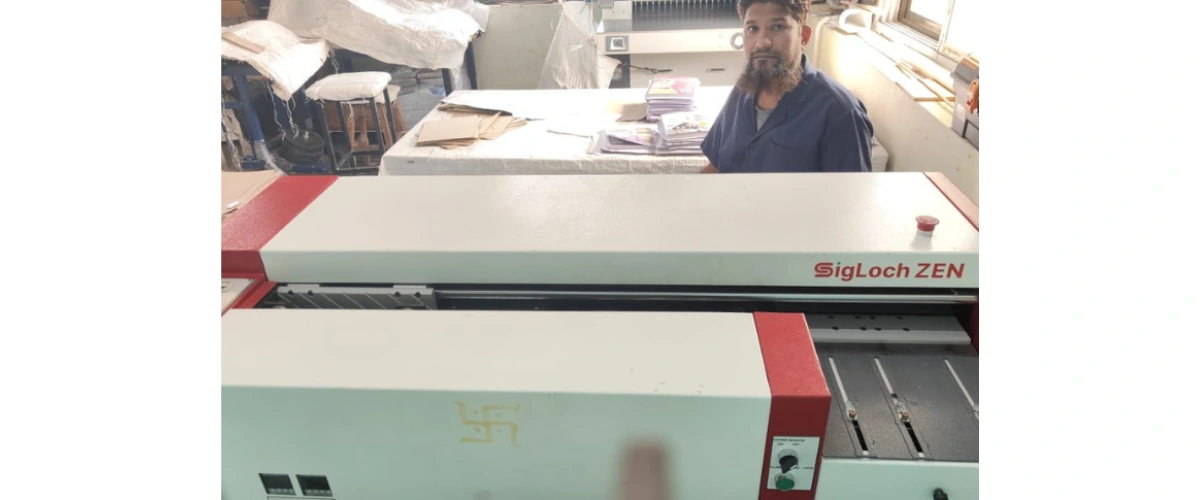
Bringing Binding Back In-House with SigLoch ZEN – Digital Perfect Binding Machine
The installation of the Bindwel SigLoch ZEN changed that equation. By bringing binding in-house, L&M achieved:
- Near-zero binding wastage
- Improved spine strength and finish consistency
- Faster turnaround without external dependencies
- Better alignment between print and bind schedules
According to the company, overall book quality improved immediately-while delays and rework were virtually eliminated.
Why L&M Chose a Digital Perfect Binding Machine from Bindwel
While evaluating options in New Delhi and Mumbai, L&M reviewed several imported machines. They ultimately decided against Chinese-made binders due to concerns around:
- Build quality
- Long-term reliability
- Service responsiveness
Bindwel stood out for three reasons:
- India-made engineering, designed for local operating realities
- Faster service response and remote troubleshooting support
- Proven robustness
for short-run digital print environments For a publisher, reliability mattered more than headline specifications.
Features That Delivered Real Production Control
Rather than focusing on specifications alone, L&M evaluated outcomes. They highlighted several aspects of the digital perfect binding machine that directly impacted quality:
- Three-roller gluing system for uniform adhesive application
- Driven side gluing, ensuring stronger page anchoring
- Consistent milling and spine preparation
- Stable cover nipping with controlled pressure
Finished books showed no spine reversal, no loose pages, and no customer rejections.