


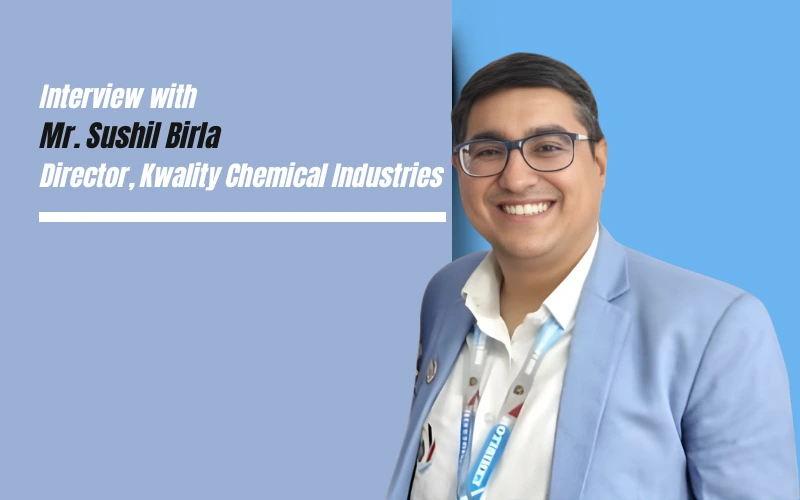
Kwality Chemical Industries delivers globally benchmarked pigments and resins—customized for Indian printing needs and priced for a competitive market.
Print3 : What inspired the foundation of Kwality Chemical Industries in 1981?
Sushil Birla : Kwality Chemical Industries was inspired with the foundation of “Make In India”. In the 1980’s, pigments were imported in India with limited domestic manufacturing. Availability, Quality customization and Price were major concerns. Mr.M.O. Birla, the patriarch worked tirelessly to develop products of international standards and more suited to the requirements of the Indian Printing Ink industry.
P3 : What were the early challenges you faced in the inks, pigments & coatings sector and how did you navigate them?
SB : The Indian print industry constantly upgrades to better print machinery with very high quality expectations. At the same time, it is fiercely competitive. It is always a challenge to innovate and offer optimum quality products at affordable prices. Kwality has navigated this challenge by looking inwards and backward integrating into the manufacturing of Resins alongwith its expertise of making Pigments to offer customers a unique combination of customized quality at attractive prices.
P3 : Can you list out all your current products and also tell us about your very first launched product?
SB : Kwality offers Printing Inks, Coatings and Ink Kitchen products for Conventional, UV, LED and Water Based.
P3 : Could you describe some of the technological innovations or proprietary processes you’ve developed (or acquired) in inks or pigments?
SB : Kwality manufactures its Printing Inks via the technologically challenging process of Flushed Pigments.
P3 : How much of your R&D is in-house vs outsourced/partnered? Do you collaborate with universities, research labs or international skill-sets?
SB : Most of our R & D is in-house.
P3 : Your website says you export to the Americas, Africa, Middle East and Southeast Asia. What have been the biggest growth regions for you internationally, and why?
SB : We have witnessed the biggest demand growth from South east Asia. The region is transforming into the manufacturing engine of the world.
P3 : How has customer demand changed in recent years (for example digital printing, packaging trends, sustainability demands)?
SB : Customers are consciously adopting sustainable solutions. Conventional Offset inks for packaging are mostly Mineral Oil free. UV Inks based on resins with bio degradable components are available with equivalent properties. Inks for flexible packaging which have traditionally been Solvent based are being replaced by Water based inks. We expect and are ourselves consciously attempting to phase out materials harmful for the environment with options that are sustainable.
P3 : How do you stay ahead of competitors in a highly commoditised industry (inks & pigments can often be pricesensitive)?
SB : Yes, Pigments and Inks, despite their immense technical requirements have become commoditized. However, each printer faces some challenges that are typical to their machine, print job, substrate, etc. The only way to differentiate apart from price is by offering customized solutions and technical know-how to resolve these challenges.
P3 : What segments (printing, packaging, coatings, plastics) do you believe hold the most untapped potential for your company?
SB : As our Country continues to grow, we expect the Packaging industry to play a vital role. Our focus continues to be on Packaging and Coatings.
P3 : How do you structure your supply-chain and logistics (raw materials, manufacturing, distribution) especially given global volatility (raw material cost, supply disruptions)?
SB : We have deep associations with our vendor partners and try our best to source locally. It helps mitigate forex and supply challenges.
P3 : What has been the biggest lesson you’ve learned in your journey that you’d share with a budding entrepreneur in the chemical/inks/coatings space?
SB : Our industry stays true to the statement, “Change is the only constant”. There are challenges everyday be it on raw materials to printing technology. My biggest lesson is that one must constantly evolve and stay up-to date with the market requirements of today.
P3 : In your view, what are the major technological shifts happening in the Indian inks/coatings/pigments industry?
SB : The shift towards sustainability is the biggest technological shift. The challenge lies in ensuring product performance with the use of new-age raw materials.
P3 : How are Indian players adapting to global standards (for example, sustainability certifications, eco-friendly inks, traceability) and how are you participating in that?
SB : We try and educate our entire supply-chain on the requirements of the end consumer. This helps us maintain proper tracking of materials in the entire value chain
P3 : Where do you see the Indian printing inks/pigments/coatings industry headed in the next 5-10 years?
SB : As the per capita Income of our country continues to rise, there shall be a definite growth of packaging and we expect to have a good growth trajectory over the next decades.
P3 : Your website lists “Sustainability & CSR” as a segment. Could you tell us about the key CSR initiatives Kwality has undertaken?
SB : Our patriarch believed in the importance of education. Based on his principles, we provide several scholarships, aids to educational institutions, etc as part of our CSR.
P3 : How do you integrate sustainability into your product development (for example ecofriendly inks, reducing solvent emissions, energy efficiency)?
SB : We are today fully committed to sustainability in every product segment. Our offset products are MO Free, our UV inks incorporate bio-renewable raw materials. Our
Water Based inks are being upgraded to print on flexible packaging at ever increasing speeds.
P3 : In manufacturing (six units, significant capacity) what steps have you taken to minimise environmental footprint or improve workplace safety?
SB : We have a robust ETP system and are moving towards ZLD scenario. We also continuously improve our process in terms of efficiency by employing recycling of materials. We have invested heavily in Solar energy by installing rooftop solar systems of 600 kW.