


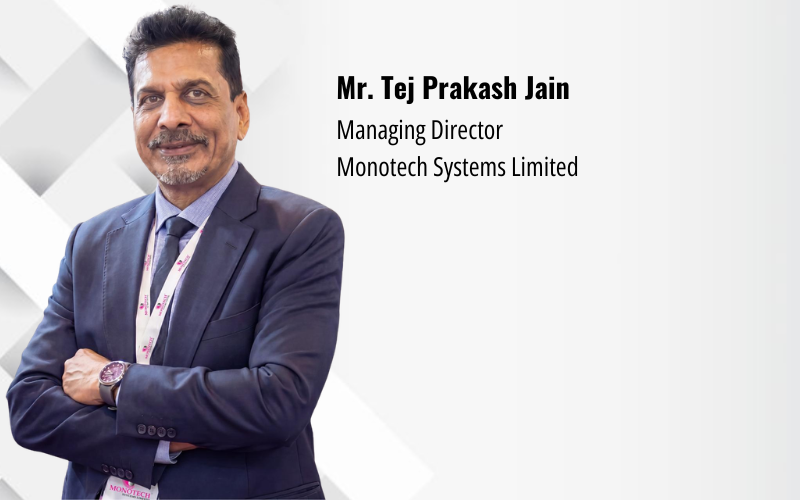
Print3 : What Made the foundation of the company in 1999, and what market gap were you aiming to address initially?
Tej Prakash Jain : Monotech Systems was founded with a simple yet ambitious vision – to bring world-class printing technologies closer to Indian businesses while developing indigenous capabilities that could compete globally. At the time, the Indian printing industry had tremendous potential, but access to advanced technologies was limited and largely dependent on imports.
Our objective was not merely to supply equipment but to become a technology partner that could help printers improve productivity, quality, and profitability. Over the years, that vision has evolved from representing global technologies to designing and manufacturing advanced digital printing and industrial inkjet solutions in India.
Innovation has always been at the heart of our journey. Today, Monotech is recognized globally for developing high-performance printing technologies that combine engineering excellence, reliability, and customer-centric innovation.
P3 : Over the last two decades, what have been the defining milestones that shaped Monotech’s journey?
TPJ : Our journey has been defined by continuous transformation.
We began by introducing advanced printing technologies to the Indian market and gradually expanded into manufacturing and product development. A major milestone was establishing our in-house R&D and manufacturing capabilities, enabling us to develop products specifically for evolving customer requirements. Another significant achievement has been our expansion into international markets. Today, Monotech solutions are installed across multiple countries, validating the quality and competitiveness of Indian engineering.
The launch of innovations such as PixelGlow, our digital print enhancement technology, and our growing portfolio in industrial inkjet, labels, packaging, and 3D printing further demonstrate our commitment to technological leadership.
Perhaps the most satisfying milestone is seeing Monotech evolve from a technology provider into a globally respected innovation-driven manufacturing company.
P3 : PixelGlow has emerged as one of your flagship innovations in digital print enhancement, What differentiates this technology from conventional embellishment systems?
TPJ : The printing industry is increasingly focused on delivering premium visual experiences while maintaining production efficiency. PixelGlow was developed with this very objective.
Unlike conventional embellishment systems, PixelGlow combines advanced digital enhancement capabilities with exceptional precision, flexibility, and production efficiency. It enables printers to produce premium tactile effects, high-build varnishes, metallic finishes, and decorative embellishments without the need for conventional dies or lengthy setup processes.
Its digital workflow allows converters to economically produce short runs, personalized applications, and high-value packaging, helping brands differentiate their products while reducing operational complexity.
More importantly, PixelGlow represents Monotech’s philosophy of developing technologies that create tangible business value for customers rather than simply introducing new features.
P3 : The global printing industry is rapidly evolving with personalization and short-run production trends. How is Monotech adapting its innovation strategy?
TPJ : Customer expectations are changing faster than ever before. Today’s print service providers require solutions that offer flexibility, faster turnaround, automation, and the ability to handle increasingly customized jobs. Our innovation strategy focuses on three key pillars: digital transformation, intelligent automation, and sustainable manufacturing.
We continue to invest significantly in industrial inkjet technologies, digital embellishment, workflow automation, and AI-enabled process optimization. These innovations help our customers increase efficiency while responding quickly to changing market demands.
Rather than developing technology for technology’s sake, we work closely with customers to solve practical production challenges. This collaborative approach ensures that every innovation delivers measurable improvements in productivity, quality, and return on investment.
P3 : Monotech has built a strong presence through both manufacturing and strategic global partnerships. How important is collaboration in your long-term business strategy?
TPJ : Innovation thrives through collaboration.
Over the years, Monotech has built strong relationships with global technology leaders while simultaneously strengthening our own manufacturing and engineering capabilities. These partnerships have enabled us to combine international expertise with Indian innovation, resulting in solutions that meet global quality standards while addressing local market requirements.
Equally important are our collaborations with customers, suppliers, research institutions, and industry associations. Customer feedback plays a crucial role in shaping our product roadmap, ensuring that our technologies continue to evolve with changing market needs.
We believe collaboration accelerates innovation, improves competitiveness, and ultimately creates greater value for the entire printing ecosystem.
P3 : India’s printing and packaging sector is witnessing rapid digital transformation. What major technological shifts will redefine the industry over the next decade?
TPJ : The Indian printing industry is entering one of its most exciting phases.
Digital printing, industrial inkjet, automation, AI-driven workflows, cloud connectivity, and smart manufacturing will fundamentally reshape production environments. The increasing demand for personalized packaging, variable data printing, shorter production runs, and faster delivery cycles will further accelerate this transformation.
Sustainability will also become a defining factor. Energy-efficient systems, environmentally responsible inks, waste reduction, and optimized production workflows will become essential rather than optional.
India possesses tremendous manufacturing capabilities, engineering talent, and entrepreneurial spirit. These strengths position the country to become not only a major consumer of printing technology but also an important global innovation hub.
P3 : How do you see India emerging as a global manufacturing hub for print technologies?
TPJ : India is well positioned to become a global hub for print technologies, driven by strong manufacturing capabilities, skilled engineering talent, and the growing demand for customized packaging, labels, and short-run digital printing.
At Monotech, we are supporting this transformation through innovations like Kolorsmart+, which enables label converters to efficiently produce high-quality short-run and variable-data labels with greater flexibility. dSpark further enhances packaging by adding premium digital embellishments that help brands create greater shelf impact.
With continued investment in indigenous R&D and advanced manufacturing under the Make in India initiative, India is not only meeting domestic demand but is also emerging as a trusted global source for innovative printing technologies.
P3 : How is Monotech balancing industrial growth with environmental responsibility?
TPJ : Sustainability is no longer simply an environmental objective – it is a business imperative.
Our product development philosophy emphasizes improving productivity while reducing environmental impact. We continuously focus on energy-efficient technologies, optimized workflows, reduced material wastage, and digital production processes that minimize unnecessary consumption.
Digital printing itself contributes to sustainability by enabling shorter print runs, reducing inventory, minimizing setup waste, and supporting on-demand production.
We believe innovation and sustainability should progress together, enabling businesses to grow responsibly while contributing to a more resource-efficient future.