


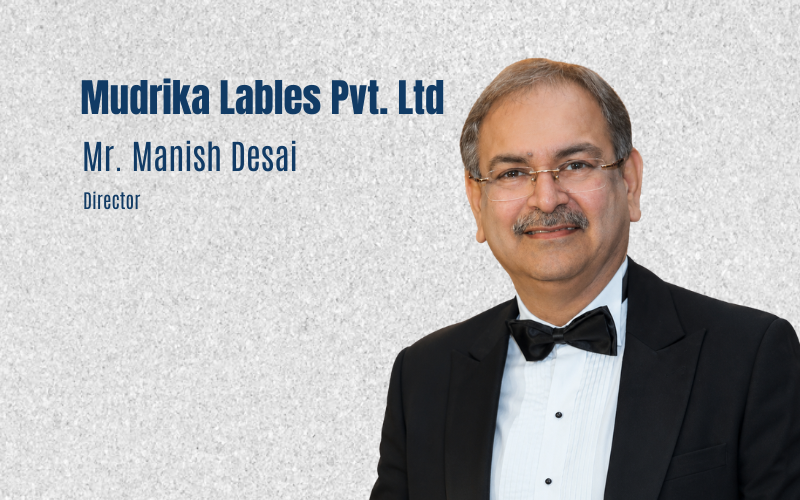
PRINT3: What were the key milestones that shaped Mudrika’s journey?
MANISH DESAI: Mudrika’s journey has been shaped by a clear belief: labelling is not merely a print commodity, but a precision-engineered packaging solution. One of our earliest milestones was the move from conventional self-adhesive labels into technically demanding solutions such as In-Mould Labelling (IML) and Heat Transfer Labels (HTL). This shift helped us support brands that needed higher durability, better aesthetics, and consistent performance across large-scale production.
Over the years, we have strengthened our manufacturing footprint, invested in modern narrow-web flexographic and offset capabilities, and built deeper in-house expertise across pre-press, material selection, quality control, and dispatch. This has allowed Mudrika to become a single-source partner for complex, multi-SKU portfolios across food and beverage, dairy, lubricants, chemicals, cosmetics, paints, agrochemicals, oils, and writing instruments.
A major new milestone is the introduction of Mudrika’s turnkey project solutions. We now support customers from the first packaging concept to commercial production – including label structure advisory, resin and substrate compatibility, artwork adaptation, prototyping, moulding-line trials, performance validation, quality documentation, and scale-up planning. This is especially valuable for brands moving into IML or HTL for the first time, because they need more than a label supplier; they need a technical partner who can help de-risk the entire transition.
P3: . How has customer-centricity influenced your growth?
MD: Customer-centricity at Mudrika is defined by technical consultation, responsiveness, and reliability. When a brand works with us, our role goes beyond accepting artwork and producing labels. We help customers evaluate materials, print effects, application conditions, substrate-to-resin compatibility, and line-speed requirements so that the final packaging performs as well as it looks. Every package must retain its appeal and integrity under real-world conditions – whether that means deep-freeze dairy logistics, moisture exposure, chemical resistance, scuff resistance, or high-speed filling and handling. Our ability to understand these challenges and provide predictable quality has helped us build long-term partnerships with brands that value consistency and technical support.
MD:Earlier, R&D in the label sector was often limited to ink adhesion, colour matching, and visual proofing. Today, our R&D approach is far more application-led. We study the interaction between films, inks, coatings, adhesives, containers, and end-use environments so that each label structure is engineered for performance.
Our current focus includes mono-material recyclability, thin-gauge films, high-durability top coatings, tactile finishes, barrier performance, and process compatibility. The goal is not only to make packaging look premium, but also to help brands meet sustainability, performance, and compliance expectations without compromising production efficiency.
P3: How do you ensure quality across diverse product categories?
MD: Quality at Mudrika is a process discipline. Across Pressure-Sensitive Labels, In-Mould Labels, Heat Transfer Labels, and Mono-Cartons, we follow defined checkpoints from raw material receipt to final dispatch. Incoming films, boards, inks, coatings, and adhesives are verified against technical specifications before they enter production.
During manufacturing, automated inspection systems, colour monitoring, densitometer checks, and mechanical tests help us control critical parameters such as adhesion, scuff resistance, print registration, and coefficient of friction. This ensures that every batch meets the customer’s approved standard and performs consistently in the intended application.
P3: What technological investments have had the biggest impact?
MD: The most important investments have been in high-speed, multi-substrate printing platforms and automated inspection technologies. Advanced narrow-web flexographic lines allow us to handle complex label constructions, multiple embellishments, and high-volume jobs with strong repeatability.
Inline camera inspection and disciplined colour-management workflows have also changed the way quality is controlled. Instead of relying only on end-stage checks, we can detect and correct deviations during production. This improves consistency, reduces waste, and gives customers greater confidence across repeat orders and multi-SKU programs.
P3: How do you identify emerging market opportunities?
MD: We identify opportunities through close engagement with customers, packaging teams, procurement heads, moulders, and brand owners. These conversations often reveal market shifts before they become visible in formal reports – for example, the movement toward recyclable mono-material packaging, high-clarity decoration, durable lubricant labels, and premium personal-care finishes. Because our teams work across industries, we can also transfer learnings from one segment to another. A durability requirement in lubricants, for instance, may inspire a stronger finish for agrochemical packaging or industrial containers.
P3: How is Mudrika helping brands improve shelf appeal?
MD: A label is one of the most visible brand assets on the shelf. Mudrika helps brands translate design intent into a repeatable, production-ready decoration that remains sharp and durable throughout the product lifecycle. Our pre-press, colour control, print registration, and finishing capabilities help deliver fine text, smooth gradients, accurate spot colours, and premium tactile effects. With IML, brands can achieve a seamless, integrated ‘no-label’ look that resists moisture, scuffing, peeling, and wrinkling. This gives the package a premium appearance while improving durability in storage, transport, and retail conditions.
P3: What role does market research play in product development?
MD: Market research helps us align our development pipeline with where packaging is moving. Trends such as anti-counterfeiting, EPR compliance, recyclable structures, lower-plastic formats, and faster filling-line performance directly influence the materials and technologies we evaluate. For example, demand for brand protection has encouraged us to look at micro-text, security effects, holographic elements, and specialty inks. Similarly, feedback from high-speed filling environments has pushed us to develop surface finishes and coatings that improve handling efficiency.
P3: What strategies have supported domestic and international growth?
MD: Our strategy is to combine international-quality manufacturing with responsive technical support and competitive value. Domestically, we have grown by helping brandconsolidate their label requirements with one reliable partner instead of managing fragmented suppliers. Internationally, we position Mudrika as an agile Indian manufacturer capable of serving global buyers with consistent quality, standardized processes, and export readiness. Our work across international markets has reinforced the importance of colour consistency, documentation, communication, and dependable lead times.
P3: How does your technical team collaborate with customers?
MD: Our collaboration typically begins with a concept or performance challenge. We then guide the customer through material selection, artwork feasibility, substrate and resin compatibility, prototype development, line-trial validation, and final commercial scale-up. For clients new to IML, HTL, or advanced label structures, this hands-on support is extremely important. Our turnkey approach reduces uncertainty because we help evaluate the label not only as a printed item, but as part of the complete packaging and production ecosystem.
P3: Which technologies are transforming the Indian label industry?
MD: The Indian label industry is being transformed by AI-assisted inspection, advanced hybrid presses, automated finishing systems, improved colour-management tools, and recyclable material science. These technologies are helping manufacturers reduce waste, improve repeatability, and deliver higher-value labels at scale. The next competitive advantage will come from companies that can combine technology with process discipline – because machines alone do not create quality; systems, training, and accountability do.
P3: How will advanced packaging technologies influence the future?
MD: Advanced packaging technologies will move the industry toward greater consistency, lower waste, and faster product development. Automated colour controls, digital workflow approvals, improved inspection systems, and precision finishing will help brands launch multi-region campaigns with confidence. For customers, the benefit will be faster approvals, fewer production surprises, and stronger alignment between design intent and final packaging output.
P3: Which emerging technologies will drive future innovation?
MD: Future innovation will be driven by functional and interactive packaging. We expect wider adoption of smart packaging integrations such as RFID and NFC, variable-data solutions for traceability, digital embellishment without physical tooling, and high-performance thin-gauge films that reduce material usage while maintaining product protection. Sustainability-linked innovation will also accelerate, especially in mono-material structures, wash-off systems, recyclable films, and coatings that support circular packaging goals.
P3: What opportunities do you see in the coming decade?
MD: The next decade presents strong opportunities for Indian packaging manufacturers. Organized retail, e-commerce, premiumization, exports, and global supply-chain diversification are all increasing demand for reliable, high-quality packaging partners. Indian companies that can combine scale with engineering support, compliance, and sustainability will be well positioned to serve both domestic and global brands.
P3: How can Indian companies improve global competitiveness?
MD: Indian companies must move from capacity-led growth to discipline-led growth. This means investing in modern equipment, standardized colour management, technical documentation, quality certifications, training, and sustainable manufacturing practices. Global customers are looking for consistency, transparency, responsiveness, and problem-solving ability. Manufacturers who provide all four will stand out.
P3: Which research areas will be most important for future growth?
MD: The most important research areas will be circular packaging solutions, including mono-material labels, high-clarity recyclable films, thin-gauge substrates, bio-based inks, sustainable coatings, and materials compatible with recycling systems.
At the same time, performance research will remain essential. Labels must continue to withstand moisture, heat, chemicals, abrasion, logistics, and retail handling while supporting a lower environmental footprint.
P3: How is Mudrika integrating sustainability into operations?
MD: For Mudrika, sustainability is not a separate statement; it is part of operational decision-making. We focus on reducing setup waste, improving process efficiency, recycling production scrap wherever possible, and working with suppliers to identify thinner films, improved liners, and responsibly sourced materials. Our product development also supports customers who are working toward recyclable packaging, mono-material formats, and EPR-linked goals.
P3: What initiatives support employees and communities?
MD: Our people are central to Mudrika’s growth. We invest in safety training, technical skill development, structured shop-floor practices, and a work culture that values precision, accountability, and continuous improvement. A strong manufacturing business is built by people who understand both craftsmanship and process discipline. We are committed to helping our teams grow with the business.
P3: How is R&D contributing to sustainability goals?
MD: R&D helps convert sustainability goals into practical packaging solutions. Our work includes testing thin-gauge films, evaluating recyclable structures, developing wash-off and compatible adhesive systems, and engineering mono-material IML solutions that allow the container and label to remain aligned within the recycling stream.
The challenge is to improve sustainability without compromising durability, print quality, or production performance – and that is where technical R&D becomes essential.
P3: What do industry awards mean to the organization?
MD: Awards and recognitions are a welcome validation of the standards our teams work toward every day. They acknowledge the effort behind consistent quality, technical precision, and customer commitment. For us, recognition is not the endpoint; it is motivation to keep improving processes, technology, training, and service quality.
P3: How do industry events contribute to growth?
MD: Industry events such as Plast India, K-show, Interpack, Arab Plast, and Propak are important platforms for learning, networking, and business development. They allow us to engage with packaging professionals, demonstrate our capabilities, understand global trends, and identify future technology directions. These events also help us communicate Mudrika’s value as a technical partner, not just a label supplier.
P3: What can customers expect in the near future? Customers can expect expanded capacity, continued
MD: investment in high-speed printing and inspection technology, wider sustainable material options, and stronger digital workflows for artwork approvals and order coordination. Most importantly, they can expect Mudrika’s new turnkey project solutions to become a core part of our customer offering. From advisory and prototyping to trials, validation, and scale-up, we will support brands through the complete packaging-decoration journey.